Gartner just published a striking figure: AI-driven automation of marketing work is expected to double from 16% in 2026 to 36% by 2028. That’s not a distant future. That’s the next 24 months. But here’s what most marketers are missing: AI personalization is only as good as the data feeding it. And with third-party cookies gone and consent regulation tightening across the EU and beyond, the window to build a first-party data infrastructure is closing fast. This post breaks down exactly what that infrastructure looks like, why the agency relationship with data has fundamentally changed, and what actions move the needle right now.
Why First-Party Data Is Now Your Brand’s Most Strategic Asset
For the last decade, marketers relied on a comfortable shortcut: third-party behavioral data purchased from data brokers or gathered via cross-site cookies. It worked. Until it didn’t. The deprecation of third-party cookies in Chrome, combined with stricter enforcement of GDPR in Europe and CCPA in California, has eliminated that shortcut permanently.
What’s left is a clear two-tier landscape. Brands with strong first-party data infrastructure — owned customer data, consented preferences, behavioral signals from their own properties — are feeding their AI targeting models with high-quality inputs. Everyone else is running campaigns on noise.
We covered how AI marketing automation frameworks are changing operational workflows, and how AI agents in B2B marketing are reshaping team structures. First-party data is the fuel that makes both work.
By the numbers
71% of consumers say they’re more likely to share data with brands they trust — but only 34% currently trust brands with their data (Salesforce State of the Connected Customer, 2026). The trust gap is your competitive opening.
What’s the Difference Between First-Party and Zero-Party Data — and Why It Matters for AI
Marketers often conflate these two, but the distinction is operationally critical — especially when you’re building AI personalization infrastructure.
First-Party Data
Behavioral data collected from your own properties — website visits, email opens, purchase history, app usage. Inferred from action. Highly valuable, but interpreted by you.
Zero-Party Data
Data customers proactively share with you — quiz answers, preference centers, survey responses, product configurators. Explicit intent. The highest-quality input for AI personalization.
For AI targeting systems — whether Meta’s Advantage+, Google’s Smart Bidding, or a CDP like Segment or Bloomreach — zero-party data is gold. It bypasses the inference step entirely. Instead of an algorithm guessing that a user might be interested in sustainable protein supplements based on browsing behavior, the user has explicitly said «I want to reduce sugar intake and I care about sustainability.» That signal trains models faster and more accurately.
How to Build a Consent-First, AI-Ready Data Infrastructure (Without Enterprise Budget)
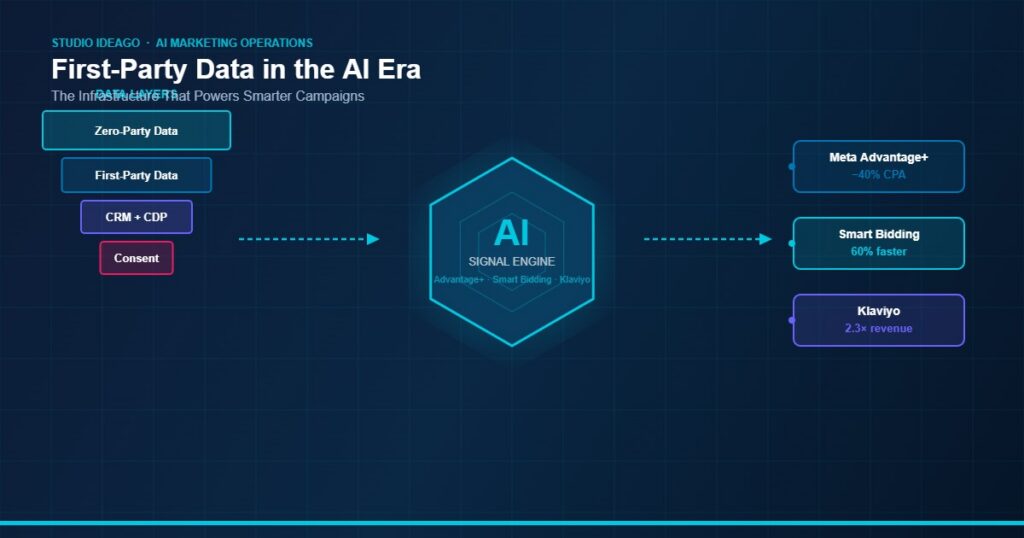
The misconception is that first-party data infrastructure requires a large tech stack and a data engineering team. It doesn’t. Here’s a practical four-layer model that works for mid-market brands and consultancy clients:
Consent Layer — Fix your CMP first
A Consent Management Platform (Didomi, CookieYes, OneTrust) is not just legal compliance. It’s the gateway to every data point you’ll collect. Without meaningful consent signals, your CDP is contaminated. Get granular consent categories: analytics, personalization, advertising — separately.
Collection Layer — Build zero-party data touchpoints
Quizzes, preference centers, post-purchase surveys, configurators, interactive content. Each touchpoint should deliver immediate value back to the user (recommendations, personalised content) in exchange for preference data. Klaviyo’s profile enrichment and HubSpot Custom Properties are the simplest activation points for most clients.
Unification Layer — A CDP or at minimum, a single source of truth
You don’t need Segment Enterprise. For most mid-market brands, HubSpot as a CRM + Klaviyo as your behavioural email platform, synced bidirectionally, gives you a workable unified customer identity. The key is tagging every contact with consent status + data source + preference attributes.
Activation Layer — Feed your AI systems
Customer lists and lookalike audiences built from first-party CRM data consistently outperform platform-native audiences on Meta Advantage+ and Google Ads. Upload enriched customer lists weekly. Use Meta CAPI and Google Ads Enhanced Conversions to send server-side signals that match your consented data back to the platforms.
Studio Ideago → For Consultants
Is your client’s data infrastructure ready for AI-driven campaigns?
Most aren’t. A quick audit reveals whether their consent layer, data collection, and CDP setup can actually support the personalization their paid channels need. Let’s map it out →
What Actually Changes When Your AI Campaigns Have Good Data
The lift isn’t marginal. When platforms receive high-quality, consented first-party signals, several things happen simultaneously:
40%
reduction in cost-per-acquisition using first-party customer lists vs. interest-based targeting on Meta Advantage+
2.3×
higher email revenue per recipient for Klaviyo flows using zero-party preference data vs. behavioral segments only
60%
faster Smart Bidding model learning when Enhanced Conversions feeds server-side signals vs. pixel-only
These aren’t theoretical improvements. They’re what happens when you eliminate signal loss. Every conversion that fires server-side instead of being blocked by browser privacy settings, every customer preference that trains your email AI rather than a guessed demographic — it compounds.
Worth noting for agency clients: The shift from agency-managed data to agencies as strategic data consultants is already underway. Digiday reported that pitches now focus on how first-party data will be used, measured, and activated — not just which platform gets the budget. If your agency positioning doesn’t include data strategy, you’re competing on price.
The Bottom Line: Data Infrastructure Is Now a Marketing Capability
The brands winning in 2026 aren’t necessarily running better creative or smarter bidding strategies. They’re winning because they built the data foundation two years ago. The good news: it’s not too late to catch up. The four-layer model above is achievable for most mid-market brands within a quarter — and the ROI compounds immediately once your AI systems have clean, consented signals to work with.
The real question isn’t whether your brand needs first-party data infrastructure. It does. The question is whether you’ll build it proactively or be forced into it reactively — by a platform policy change, a regulatory fine, or a campaign that suddenly stops working.
Studio Ideago → AI Marketing Operations
Ready to audit your data infrastructure?
We help marketing teams and agencies map consent layers, unify customer data, and configure first-party signals for Meta CAPI, Google Enhanced Conversions, and HubSpot. One session, clear action plan.
Book a Free Strategy Session →