Every client asks some version of the same question: «Is our marketing actually working?» The honest answer, for most teams, is: they don’t really know. Not because the data isn’t there — it’s drowning in it. But because their attribution model was set up in 2021 and hasn’t been touched since. In 2026, with AI-driven bidding, cookieless targeting, and fragmented buyer journeys across 27+ touchpoints, that’s not just a measurement problem. It’s a strategy problem.
This post breaks down what actually works for marketing attribution in 2026 — specifically for teams running Google Ads, Meta, HubSpot, and Klaviyo — and how AI is changing the way we assign credit, allocate budget, and justify spend to clients.
Why Your Current Attribution Model Is Probably Wrong
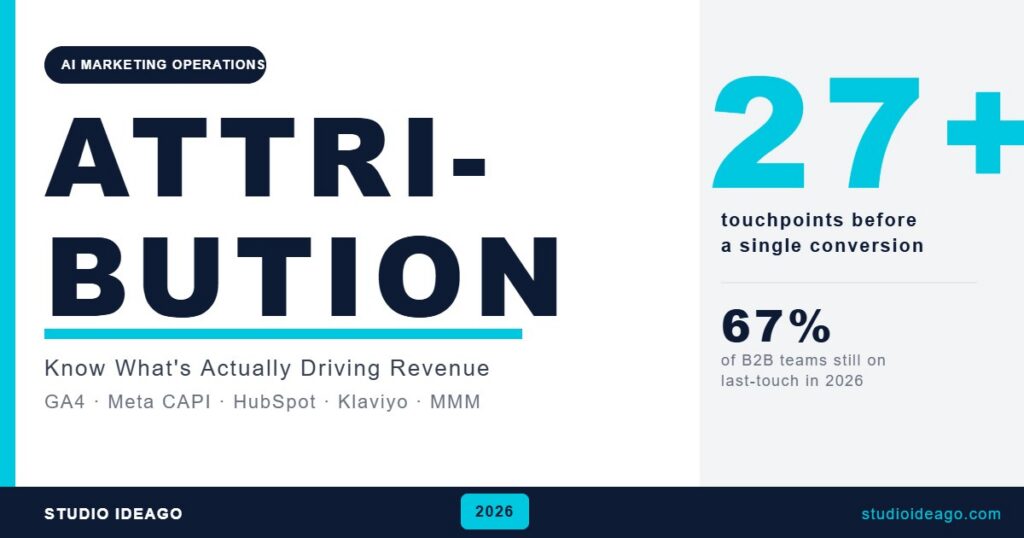
Last-touch attribution is still the default in most Google Analytics 4 accounts, most HubSpot portals, and most ad platform dashboards. And in 2026, 67% of B2B marketing teams still rely on it. The model is simple: whoever touched the customer last gets all the credit. The problem is that nobody buys that way anymore.
A typical mid-market buyer in 2026 interacts with your brand across 20–30 touchpoints before converting: a LinkedIn post catches their eye, they Google your category term, read a comparison article, see a retargeting ad, watch a short video, get a cold email sequence, book a demo via a branded search. Last-touch says the branded search got the sale. That’s like giving the finish line all the credit for winning a marathon.
Multi-touch attribution adoption has jumped from 31% to 47% since 2023 — but the real shift is that leading teams now run two models in parallel: multi-touch for tactical decisions and marketing mix modeling for strategic budget allocation. Single-model attribution died with the cookie.
The death of third-party cookies accelerated this. When you can’t track users across the web, your last-touch numbers get even more distorted — more conversions appear «organic» or «direct» because the referral chain is broken. This is why Meta’s Advantage+ and Google’s Smart Bidding both now rely heavily on first-party signals: they’re trying to fill the tracking gap that your attribution model can’t see. We covered the data infrastructure side of this in depth in our post on first-party data in the AI era.
The Three Attribution Models Worth Using in 2026
Not all attribution models are created equal, and the right choice depends on your business type, sales cycle, and stack. Here’s the practical breakdown for teams running the tools Nacho’s clients actually use:
GA4’s data-driven attribution uses machine learning across your conversion data to assign fractional credit to each touchpoint based on actual statistical impact. It requires a minimum volume of conversions to activate, but when it’s on, it’s the closest thing to honest attribution Google can give you. Enable it in GA4 under Admin → Attribution Settings, and sync it to your Google Ads account. This directly improves Smart Bidding decisions because the algorithm feeds on better-weighted conversion signals.
For B2B SaaS teams with long sales cycles (FuelFinance, Cropster), linear attribution gives every touchpoint equal credit — which is fairer than last-touch but still crude. Time-decay improves on this by weighting more recent interactions higher, which maps better to how deals actually progress. HubSpot’s attribution reports support both. The key move: set up contact-level attribution using the «Original Source» and «Latest Source» fields together, then track pipeline stage-by-stage to see which channels accelerate velocity, not just generate leads.
MMM is the model that doesn’t care about cookies at all — it works at an aggregate level, correlating spend across channels with revenue over time using statistical regression. Meta has released its open-source Robyn MMM tool; Google has LightweightMMM. For ecommerce brands (Alma Balance), running even a simplified MMM quarterly gives you a channel-level truth that no last-touch dashboard can match. It’s slower and less granular, but it’s honest in a way that click-based models can’t be.
How AI Is Changing Attribution Right Now
The most important shift in 2026 isn’t a new attribution model — it’s that attribution is increasingly happening inside the platforms themselves, and your job is to feed them the right signals. Here’s what that looks like in practice:
Meta Advantage+ Attribution: Meta’s AI bidding system (Advantage+) uses a 7-day click / 1-day view attribution window by default, but increasingly it’s operating on modeled conversions — events it statistically infers happened even without pixel fires. This is why Meta CAPI (Conversions API) matters so much: it sends server-side events that Meta can match to its modeled data, giving Advantage+ better signal quality. Without CAPI, you’re letting Meta model in the dark.
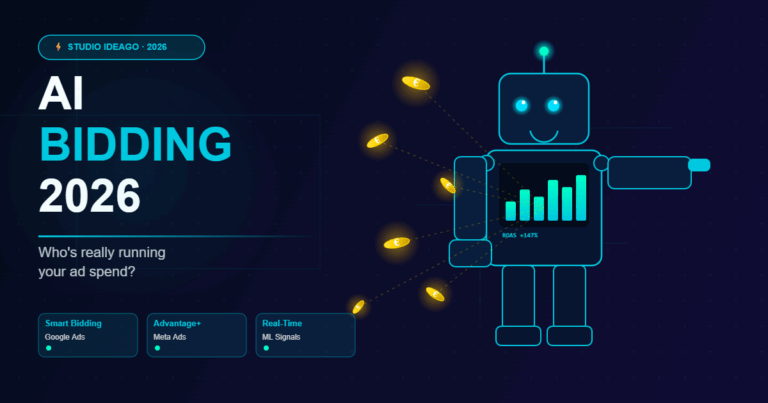
Google Smart Bidding + Enhanced Conversions: The same principle applies. Google’s Enhanced Conversions for Web sends hashed user data (email, phone) from your checkout or lead form back to Google, letting Smart Bidding connect ad clicks to conversions that GA4 would otherwise lose. Combined with data-driven attribution in GA4, this creates a feedback loop where your bidding algorithm gets smarter every week. We broke down how this ties into campaign performance in our AI bidding guide for 2026.
Klaviyo Attribution Windows: Klaviyo defaults to a 5-day email attribution window — meaning if someone opens your email and buys within 5 days, Klaviyo claims the revenue. This often overlaps with a Meta or Google Ads attribution window, causing double-counting. The fix: align your attribution windows across platforms (or consciously decide how to handle overlap), and use UTM parameters on all Klaviyo email links so GA4 can see the full journey independently.
30–40% of B2B buyer touchpoints happen in untracked channels: analyst calls, peer referrals, LinkedIn DMs, Slack communities. No attribution model captures these. The solution isn’t better tracking — it’s adding a «How did you hear about us?» field to your lead forms and booking pages, and feeding that data back into HubSpot manually.
Building an Attribution Stack That Actually Works
The goal isn’t perfect attribution — that doesn’t exist. The goal is directionally accurate attribution that helps you make better budget decisions and stop defending channels that aren’t pulling weight. Here’s the minimum viable attribution stack for 2026:
| Layer | Tool | Purpose |
|---|---|---|
| Pixel + Server-Side | Meta CAPI + Google Enhanced Conversions | Feed AI bidding clean signal |
| Analytics | GA4 (data-driven attribution) | Cross-channel journey view |
| CRM Attribution | HubSpot (Original + Latest Source) | Pipeline stage velocity |
| Email Attribution | Klaviyo (UTM-tagged links) | Flow vs campaign revenue split |
| Qualitative | Post-purchase surveys / HDYHAU | Capture dark touchpoints |
The secret to making this stack useful: UTM discipline. Every single link from every ad, email, social post, and LinkedIn message needs consistent UTMs. When they’re inconsistent, GA4 can’t join the data and you end up with 40% of your traffic in the (direct) / (none) bucket — which tells you nothing. Run a UTM audit quarterly and make it a non-negotiable in your agency processes.
Conclusion: Attribution Is a Business Decision, Not a Tech Problem
The teams winning on attribution in 2026 aren’t the ones with the fanciest tooling — they’re the ones that picked a model, aligned it across stakeholders, and committed to using it consistently to make decisions. That means the CFO sees the same attribution picture as the media buyer. It means budget conversations are driven by data, not channel advocates. And it means you can have an honest conversation with a client about what’s working instead of defending a dashboard that was designed to make everything look good.
Start with your biggest gap: if you’re not running Meta CAPI and Google Enhanced Conversions today, that’s your Week 1 priority. Everything else builds from there.
Ready to Fix Your Attribution Stack?
We audit and rebuild attribution setups for marketing teams: GA4, HubSpot, Meta CAPI, Google Enhanced Conversions, and Klaviyo — aligned into one coherent picture. No cookie-cutter reports.
Book a Free Audit Call →