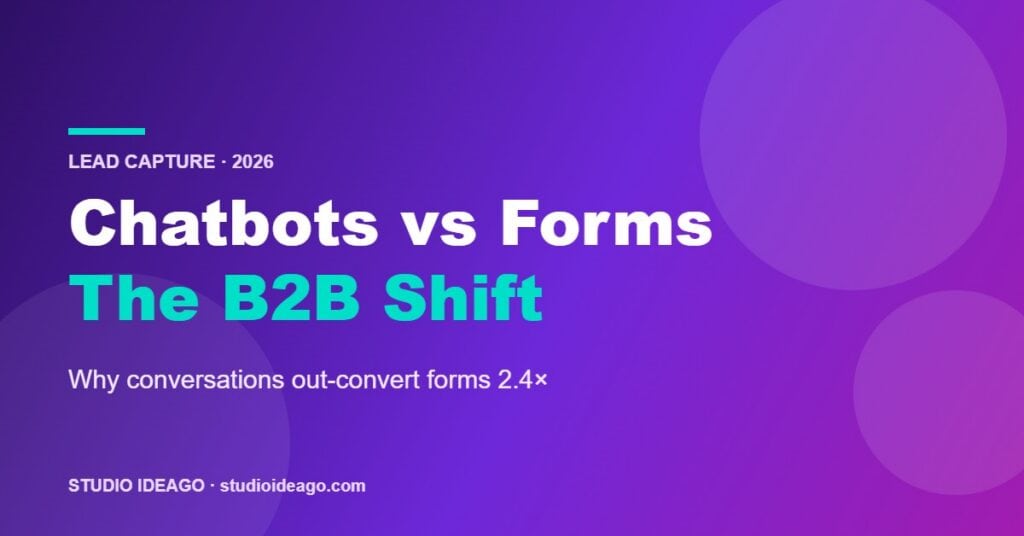
Your B2B lead form is quietly leaking pipeline. Not because the offer is weak or the traffic is bad — but because a static form asks a stranger to fill in eight fields before it gives them anything back. In 2026, the teams winning the lead-capture game stopped treating the form as a toll booth and started treating it as a conversation. AI chatbots now convert 15–30% of traffic where forms convert 2–5%, and the gap is no longer a novelty — it’s a structural advantage. The question for a B2B marketer isn’t whether to use conversational capture. It’s where it earns its keep and where a plain form is still the smarter call.
Marketing Automation & CRO
Why Do Chatbots Convert So Much Better Than Forms?
The numbers are genuinely lopsided. Chatbot-led funnels convert at roughly 2.4× the rate of static web forms, and conversational lead capture generates around 55% more high-quality leads than the form-based equivalent. Some integrated deployments report up to a 300% lift versus a static form. Those aren’t edge cases — they’re the new baseline once you understand the mechanism.
A static form is a wall of demands presented before any value is exchanged. It asks for name, company, email, phone, job title, company size, and «how can we help?» — all at once, all up front. Every field is a reason to abandon. A conversation inverts that. It asks one question, reacts to the answer, and only asks the next thing when the previous answer earned it. The prospect never sees the wall; they see a thread that feels like it’s going somewhere.
There’s a psychological lever underneath this called the sunk-cost or commitment effect. Answering an easy first question («What are you trying to fix?») creates small momentum. By the time the bot asks for an email, the prospect has already invested three answers and wants the payoff. The form asks for everything before any momentum exists, which is exactly why it stalls.
A form collects data. A conversation qualifies a buyer. Those are different jobs — and in B2B, where you need to know budget, authority, and timeline before you route a lead, the second job is the one that actually moves revenue.
When Should You Use a Chatbot — and When Is a Form Still Better?
This is where most «chatbots beat forms» articles fall apart: they treat it as a religion. It isn’t. Each tool wins a different job, and a mature B2B stack uses both deliberately.
| Use case | Better tool | Why |
|---|---|---|
| High-intent demo / pricing page | Chatbot | Qualify and route to a rep in real time; book the meeting before intent cools |
| Gated content / whitepaper | Form (short) | Low intent, transactional; a 2-field form removes friction faster than a chat thread |
| Complex qualification (enterprise) | Chatbot | BANT/MEDDIC logic branches on answers; a static form can’t adapt |
| Newsletter / simple opt-in | Form (inline) | One field, zero qualification needed; conversation adds overhead for no gain |
The pattern is clear once you see it: the higher the intent and the more complex the qualification, the more a conversation wins. The lower the intent and the simpler the ask, the more a short form wins. A demo request should never be a 9-field form. A newsletter signup should never be a five-message chat.
Don’t replace every form with a bot. Map intent to format: conversations for high-intent, complex-qualification moments; short forms for low-intent, transactional ones. The leak isn’t forms — it’s using a form where the moment called for a conversation.
A 9-field demo form is the single most common, most expensive mistake in B2B lead capture.
How Do You Qualify a B2B Lead Inside a Chat — Without Sounding Like a Bot?
B2B is not B2C. A B2C bot can capture an email and call it a win. A B2B bot has to surface company size, budget authority, and timeline before it routes anyone — because deals are large and sales cycles run months, not minutes. This is where frameworks like BANT (Budget, Authority, Need, Timeline) and MEDDIC earn their place: they become the branching logic of the conversation.
Lead with need, not interrogation. The first question should be about the prospect’s problem, never about their budget. «What are you trying to solve?» opens the thread. «What’s your budget?» closes it. Qualification questions come after the bot has delivered something useful — a relevant resource, a quick diagnostic, a tailored next step.
Branch on the answers. If someone says they’re «just researching,» the bot shouldn’t push for a sales call — it should offer content and capture a soft email. If they say they’re «evaluating vendors this quarter,» that’s a hot lead and the bot should move straight to booking time with a rep. A static form treats both identically. That’s the whole difference.
Route, don’t just collect. The output of a good B2B chatbot isn’t a row in a spreadsheet — it’s a scored, routed lead that lands in the right rep’s queue with context attached. That routing layer is where conversational capture connects to your CRM and your wider operating system, which is the same systems-thinking we mapped in Loop Marketing: capture is just the entry point of the loop, not the finish line.
Is your highest-intent page hiding behind a long form?
Most B2B teams have one or two pages where intent is high and a static form is silently killing conversions. I help map which moments deserve a conversation and which don’t — then wire the qualification logic into your CRM so leads arrive scored and routed, not raw.
What’s the Real ROI — and the Real Risk?
The financial case is strong. Average first-year ROI for an AI lead-generation chatbot lands at 148–200%, with well-integrated deployments reporting up to 340%. Teams typically cut cost-per-lead by 40–60% because the bot does the qualifying work a junior SDR used to do on inbound. Adoption has followed: around 60% of B2B companies now run chatbots in some form, up sharply from a couple of years ago.
But the risk is just as real, and it’s usually self-inflicted. A badly designed bot — one that loops, can’t escalate to a human, or interrogates before it helps — converts worse than the form it replaced. The 2.4× advantage assumes a bot that’s genuinely conversational and genuinely useful. Bolt a clunky decision tree onto your pricing page and you’ll just annoy your best-fit buyers.
Three guardrails separate the winners from the cautionary tales: always offer a fast path to a human, never ask a qualifying question before delivering value, and feed every conversation back into your data layer so the bot gets smarter and your routing gets tighter. That data-feedback loop only works if your underlying data is clean — the foundation we covered in First-Party Data in the AI Era.
The Bottom Line: Conversation Where It Counts
The static form isn’t dead — it’s just been demoted. For low-intent, transactional captures, a short form is still the cleanest tool you have. But for the moments that actually decide pipeline — the demo request, the pricing inquiry, the enterprise evaluation — a conversation that qualifies, branches, and routes will out-convert a form by a wide and consistent margin.
The winning move in 2026 isn’t «chatbots everywhere.» It’s surgical: identify the two or three high-intent moments where your form is leaking, replace them with a conversation built on real qualification logic, and wire the output into your CRM so every lead arrives scored and routed. Do that and you don’t just capture more leads — you capture better ones, and you hand your sales team a head start instead of a spreadsheet.
Lead capture stopped being a data-collection problem years ago. It’s a qualification problem now — and qualification is a conversation.
Turn your highest-intent pages into conversations that qualify
I help B2B teams replace leaky forms with conversational capture where it counts — built on BANT/MEDDIC qualification logic, routed into your CRM, and designed to hand sales a scored lead instead of a raw one. No bolt-on bot. A capture system that earns its conversion lift.