How a Nordic Last-Mile SaaS Replaced Manual Lead Qualification with an AI Crew and Generated €1.4M of Pipeline in 90 Days
NorthRoute (name anonymised) had a strong route-optimization product but a go-to-market that didn’t scale: SDRs hand-qualified every form fill, the HubSpot was full of duplicates, and Google Ads burned budget on broad logistics terms with no feedback loop to sales. We built them an automated marketing department — an AI Crew running 24/7 — and rebuilt the CRM and ad engine around it.
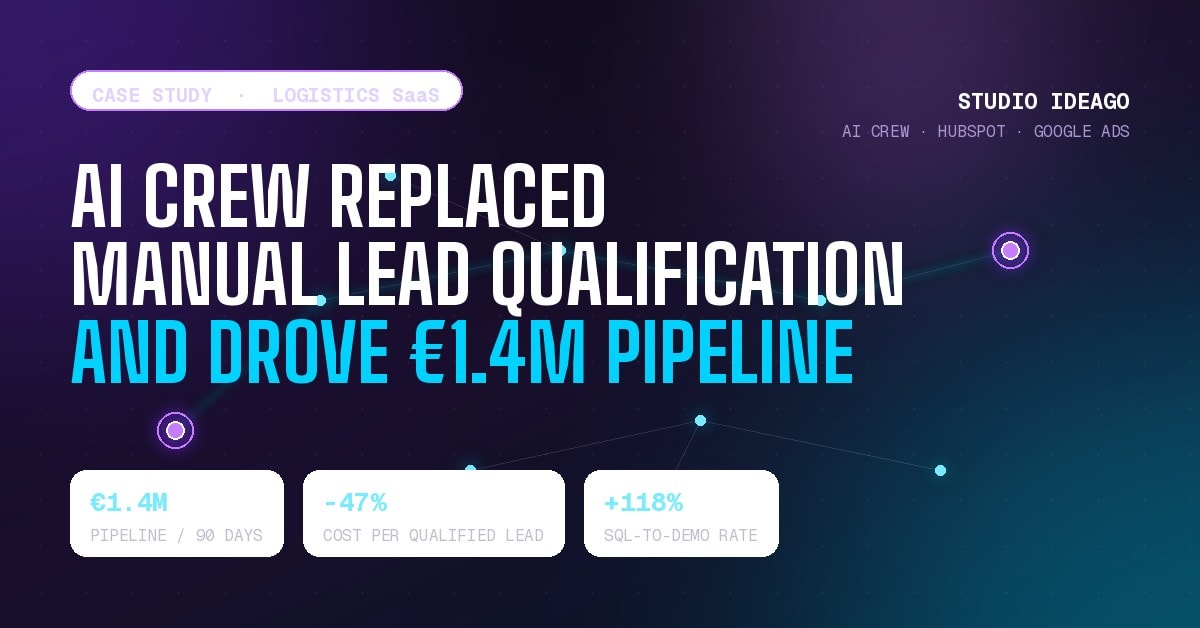
generated in 90 days, with cost per qualified lead down 47% and SDRs freed from ~22 hours/week of manual work
The situation
The challenge
NorthRoute (name anonymised) is a B2B SaaS selling last-mile delivery and route-optimization software to mid-market e-commerce operators and 3PL providers across the Nordics and Germany. They had a genuinely good product and growing demand — but the engine behind the growth was held together by hand. Every inbound form fill landed in an inbox where an SDR manually researched the company, decided whether it was worth a call, and typed notes into a HubSpot portal that had three years of duplicate records and no scoring logic. Response times stretched to four hours or more, and by then the best prospects had already booked a demo with a competitor. On the paid side, a single Google Ads campaign was bidding on broad terms like «delivery software» and «logistics platform» with no offline-conversion feedback — so Smart Bidding optimized toward whatever generated the most raw form fills, not the leads that actually became qualified opportunities. As they pushed into the German market, cost per acquisition was climbing and nobody could say which spend was producing real pipeline.
Our approach
What we built together
An AI Crew that qualifies and routes leads 24/7
We built an automated marketing department around their funnel: every inbound lead is enriched (company size, industry, region, tech signals), scored against their ideal customer profile, and routed to the right SDR with a ready-made context summary. High-fit leads get an instant, personalised first-touch within minutes instead of hours — the AI Crew never sleeps, never skips a lead, and never forgets to follow up.
HubSpot rebuilt around scoring and lifecycle logic
We deduplicated three years of contacts, restructured the lifecycle stages (Subscriber → MQL → SQL → Opportunity → Customer) to match their real sales motion, and deployed a scoring model combining firmographic fit with behavioural signals (demo requests, pricing visits, repeated engagement). Sequences automated nurture for leads not yet sales-ready, so nothing leaks out of the funnel.
Google Ads rebuilt around real qualified leads
We restructured the account into intent-tiered campaigns — Brand, High-Intent Category, Competitor, and Mid-Funnel — and cut broad match across all non-brand campaigns. Critically, we fed offline conversions back from HubSpot: when a lead becomes an SQL, Google Ads learns from it. Smart Bidding now optimizes toward qualified pipeline, not vanity form fills.
Automated reporting the whole team trusts
The AI Crew generates a weekly pipeline digest for the founders and sales lead: leads by score, cost per qualified lead by campaign, response-time SLA compliance, and recommended actions. Decisions that used to wait for a manual spreadsheet pull now happen on a Monday-morning summary that builds itself.
Results
The numbers
How it happened
The process
Audit + ICP and scoring design
Full audit of the HubSpot portal, the Google Ads account, and the manual lead-handling process. We mapped exactly where leads were lost and how long each step took. Defined the ideal customer profile, the lead-scoring model, and the routing rules before building anything — so the automation reflected their real sales motion, not a generic template.
AI Crew build + HubSpot rebuild
Deduplicated and restructured the CRM, deployed lifecycle stages and lead scoring, and built the AI Crew: enrichment, scoring, instant routing, and automated first-touch. Migrated the contact database into the new structure and connected the enrichment and follow-up workflows. First leads flowing through the automated pipeline by week 5.
Google Ads restructure + offline conversions
Rebuilt the Ads account into intent-tiered campaigns, killed broad-match waste, and wired offline conversion import from HubSpot so Smart Bidding optimizes toward SQLs. Response time drops below five minutes as the AI Crew handles first-touch automatically. CPL begins falling as budget shifts to campaigns producing qualified pipeline.
Optimization + German-market scale
Cost per qualified lead down 47% against baseline. SDRs freed from ~22 hours of manual qualification a week, now spending that time on live conversations. With clean attribution in place, we scaled German-market campaigns on the same architecture — confident that every euro of new spend was being judged on qualified pipeline, not raw volume. Pipeline generated reaches €1.4M by day 90.
«We thought we needed more leads. What we actually needed was a system that knew which leads mattered and acted on them instantly. The AI Crew does the work three SDRs used to do — and it does it before a competitor can even reply.»
— Head of Growth, Last-Mile Logistics SaaS — Nordics