Personalization used to mean putting a first name in an email subject line. In 2026, it means your CRM predicts which accounts are 72 hours away from churning, your ad platform serves a different landing page to each ICP segment in real time, and your email sequence adapts its next message based on what the prospect just did on your site. This is AI personalization at scale — and most B2B marketing teams are still operating with 2022 playbooks. This post gives you the actual framework to close that gap.
AI Marketing Operations
What AI Personalization at Scale Actually Means (and What It Doesn’t)
The term gets used to describe everything from dynamic email subject lines to full autonomous campaign orchestration. Let’s be precise.
Basic personalization — first name tokens, segment-based email variants, geo-targeted ads — is table stakes. You’re already doing this. 59% of B2B marketers describe their personalization as still «basic,» meaning one to two channels with minimal data integration. That’s the gap.
AI personalization at scale is something different. It means:
- Predictive signals, not reactive segments — the AI identifies buying intent before the prospect self-identifies
- Real-time content adaptation — website copy, ad creative, and email content shift based on live behavioral signals
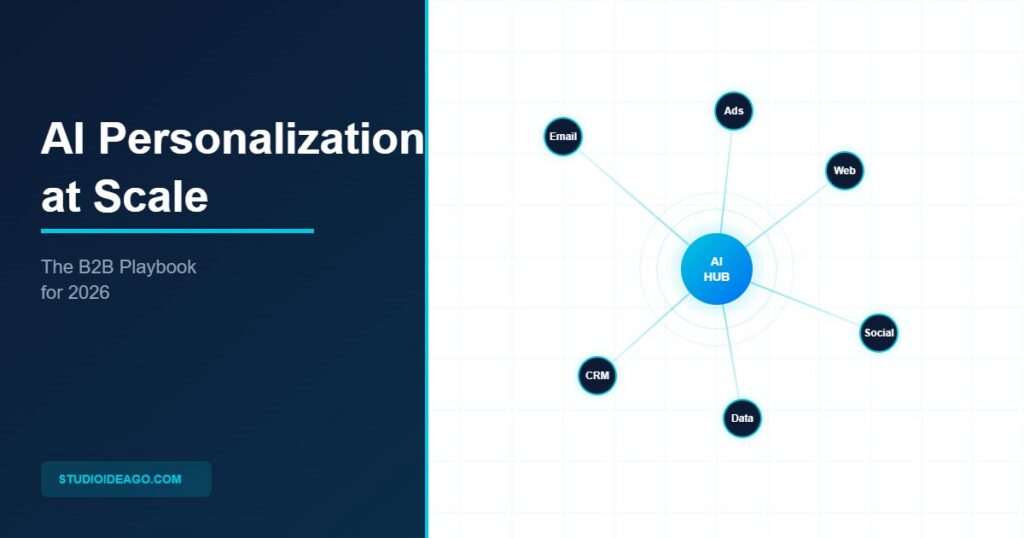
- Cross-channel coordination — a single behavioral event (e.g. viewing a pricing page) triggers coordinated responses across email, ads, CRM, and sales alerts simultaneously
- Individual-level treatment — not segments of thousands, but micro-segments of tens or true 1:1 experiences
77% of B2B buyers won’t make a purchase without personalized content. Yet only 42% of marketing teams have the platform integration to execute personalization across channels. That gap is where your competitive advantage lives.
The 3-Layer Infrastructure Every B2B Team Needs
AI personalization doesn’t fail because of bad AI. It fails because of bad infrastructure underneath it. Before touching any personalization tool, make sure these three layers are in place.
Layer 1 — Unified Data Foundation
Your CRM, ad platforms, website analytics, and product usage data need to speak to each other. In 2026, 72% of B2B companies collect and unify behavioral and transactional data for account-based experiences — but the operative word is «unify.» Data sitting in silos (HubSpot contacts disconnected from GA4 events, ad click data never mapped to CRM deals) produces personalization that feels generic at best, creepy at worst.
Minimum viable stack: CRM (HubSpot or Salesforce) + web analytics (GA4) + ad platforms (Meta, Google) connected via a data layer — whether that’s a CDP, a warehouse like BigQuery, or at minimum proper UTM discipline and HubSpot contact tracking turned on.
Layer 2 — Behavioral Signal Capture
You can’t personalize what you don’t see. This means instrumenting every high-intent touchpoint: pricing page visits, feature comparison downloads, webinar attendance, support ticket themes, email click patterns, product trial events. Each of these is a signal the AI can act on. Without them, the «AI» is just firing generic nurture sequences at everyone.
57% of B2B marketers use behavioral data to personalize email — but the ceiling is much higher. The teams seeing 40% more revenue from personalization are the ones who’ve mapped 15–20 distinct behavioral signals into their scoring and segmentation models.
Layer 3 — Activation Layer (the AI itself)
This is where the platforms live: HubSpot’s Breeze Intelligence for contact enrichment and intent scoring, Meta’s Advantage+ for creative personalization, Google’s AI Max for search personalization, Klaviyo’s predictive analytics for email. The AI layer is actually the easiest part to set up — the problem is it has nothing to work with if layers 1 and 2 are broken.
AI personalization fails at the infrastructure level, not the intelligence level. Most teams are trying to run advanced personalization on a foundation that isn’t ready for it.
Fix the data plumbing first. The AI takes care of itself once the signals are there.
How to Implement AI Personalization Across Your Key Channels
Once the infrastructure is in place, here’s how to activate personalization in the channels that matter most for B2B in 2026.
Email: Beyond Segment-Based Nurture
The shift from segment-based to behavior-triggered email is the single highest-ROI move available to most B2B teams. Instead of «everyone in the Enterprise segment gets email sequence A,» you build flows triggered by specific signals: visited pricing page → send competitive comparison. Downloaded ROI calculator → route to sales with enriched context. Attended demo → send case study from their exact industry vertical.
In HubSpot, this means rebuilding your workflows around contact properties and behavioral triggers rather than list membership. Combine this with HubSpot’s Breeze AI content assistant to generate personalized email variants at scale — different messaging for CFO persona vs. CMO persona hitting the same account.
Paid Ads: Let the Platform’s AI Work (Within Your Brand)
Meta’s Advantage+ and Google’s Performance Max are doing AI personalization at a scale no human team can match — serving different creative combinations to different users based on behavioral signals, lookalike clusters, and real-time intent. The mistake most teams make is fighting this by over-constraining the audience and over-prescribing the creative.
Your job in 2026 is to be a great creative director, not a media buyer. Feed the platform 8–12 strong creative variants (different hooks, different value propositions, different formats), set broad parameters, and let the AI find the winning combinations. The teams getting the best ROAS are the ones who’ve stopped trying to manually control targeting and started optimizing the creative input instead.
If you’re running Google or Meta campaigns, the AI bidding layer underneath your ads is already making personalization decisions. Read AI Bidding in 2026: What Smart Bidding and Advantage+ Are Actually Doing to understand what’s happening under the hood.
Website: Dynamic Content Personalization
This is the most underutilized channel in B2B. Your homepage currently shows the same content to a first-time visitor from a 10-person startup and a returning VP of Marketing from a 500-person company that’s been reading your blog for three months. That’s a massive missed opportunity.
Tools like HubSpot’s Smart Content, Mutiny, or Optimizely let you serve different CTAs, headlines, and social proof based on known contact properties (pulled from CRM via cookie) or firmographic data (inferred from IP). Even a simple rule — show ROI-focused messaging to returning visitors from accounts in your ICP — can meaningfully lift conversion rates.
Is your marketing stack ready for AI personalization?
Most teams are investing in AI tools before fixing the data foundation underneath them. I audit marketing stacks for B2B companies and identify exactly where the gaps are — before you waste budget on tools that won’t work.
The AI Personalization Maturity Model: Where Are You Now?
Not every team needs to be at the frontier. Here’s a practical way to self-assess and identify the next most valuable step.
| Level | What you have | Next move |
|---|---|---|
| Level 1 | First name tokens, list-based email segments | Add behavioral triggers to email workflows |
| Level 2 | Behavioral email triggers, CRM contact scoring | Connect ad audiences to CRM data, add smart content to website |
| Level 3 | Cross-channel coordination, account-level personalization | Build predictive lead scoring, enable AI content variants at scale |
| Level 4 | Predictive intent scoring, real-time cross-channel orchestration | Deploy agentic workflows — AI that acts without human triggers |
Most B2B teams I work with are at Level 1 or early Level 2 — not because the tools are hard, but because the data plumbing isn’t ready. The fastest path to Level 3 is almost always fixing data unification before buying new personalization software.
If you’re curious how this connects to building a fully scalable content operation — the kind that feeds your personalization engine with fresh material automatically — read AI Content Operations: How to Build a Scalable Content Machine with AI Agents.
The Bottom Line: Personalization Is Now a System, Not a Feature
The teams winning at AI personalization in 2026 aren’t the ones with the most sophisticated tools. They’re the ones who treated personalization as a system — investing in data infrastructure, behavioral signal capture, and cross-channel coordination before worrying about which AI platform to buy.
The ROI is real: companies that excel at personalization generate 40% more revenue than average. But it requires a shift in how you think about marketing operations — from campaign execution to signal-driven orchestration. AI doesn’t replace that strategic thinking. It just executes it at a scale no human team could reach alone.
Start with an honest audit of where you are on the maturity model. Fix the layer that’s broken. Then let the AI amplify what’s working.
Ready to build your AI personalization stack?
I work with B2B marketing teams to audit their current stack, identify the highest-leverage gaps, and build a roadmap for AI-powered personalization. No generic recommendations — just what makes sense for your specific setup and goals.