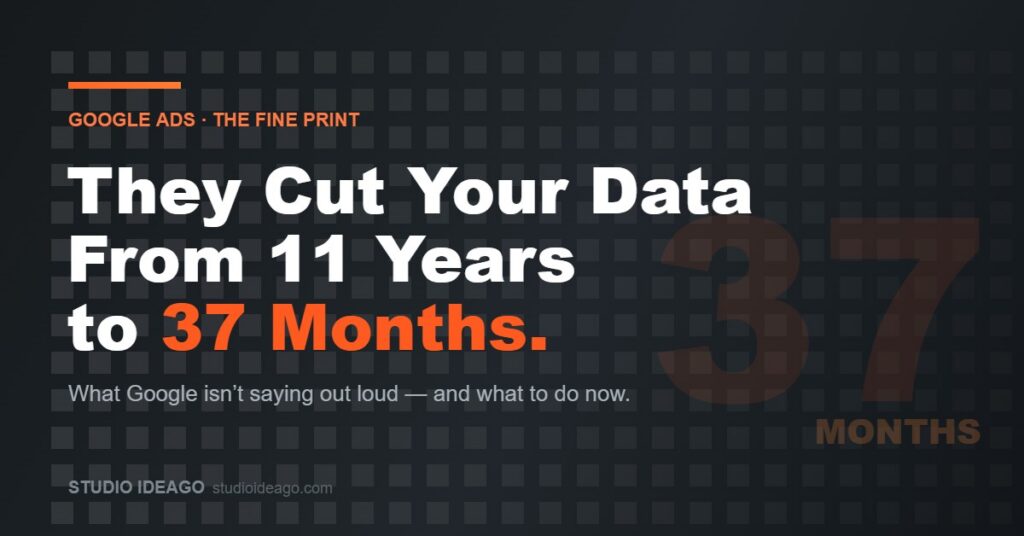
In November 2024, Google made a promise: eleven years of Google Ads reporting data, kept and queryable. Eighteen months later, on June 1, 2026, it quietly walked most of that back. Granular performance data — the hourly, daily and weekly numbers you actually use to diagnose a campaign — now lives for just 37 months. Google filed it under «data retention policy update,» the most sleep-inducing phrase in its vocabulary. That’s the point. A change framed as housekeeping is almost never housekeeping. Read between the lines and this is a decision about who owns the memory of your campaigns — and the default answer just stopped being you.
Google Ads · Measurement
What Actually Changed on June 1, 2026?
Here’s the plain version. Starting June 1, 2026, Google Ads splits reporting data into two buckets with very different lifespans. Granular data — anything measured at hourly, daily or weekly resolution — is retained for 37 months. Aggregated data — monthly, quarterly and annual roll-ups — keeps the eleven-year horizon Google announced back in November 2024. Reach and frequency metrics get an even shorter leash: three years, after which they vanish from both the interface and the API.
On paper it sounds tidy. In practice, the bucket that got cut is the one that matters. Nobody troubleshoots a campaign using an annual roll-up. You troubleshoot with day-level and week-level data — the exact resolution now capped at 37 months. So while Google can technically say «we still keep eleven years of data,» the data you’d reach for in a real analysis is the data that now expires first.
When a platform keeps the headline number («11 years!») but quietly shortens the resolution you’d actually query, the headline is for the press release and the fine print is for you. The retention window didn’t shrink. Your useful retention window shrank by roughly two-thirds.
Why Would Google Cut From 11 Years to 3 in 18 Months?
This is the question the announcement doesn’t answer, so let’s answer it honestly. Google will cite storage cost and «simplification.» Maybe. But you don’t stand up an eleven-year retention promise in late 2024 and gut it a year and a half later because the storage bill surprised you. Something in the strategy changed, and the timing is the giveaway.
Look at what else happened in the same window. Google spent 2025 and 2026 pushing advertisers hard toward Smart Bidding, Performance Max and AI-driven automation — systems that decide where your money goes without showing you the working. The entire pitch is «trust the algorithm.» Now consider what long, granular history is for: it’s the raw material you’d use to independently audit whether that algorithm is actually delivering, to reverse-engineer why performance shifted, to calibrate your own attribution or marketing-mix models against Google’s black box.
Shorten that history and you quietly weaken every one of those checks. It’s harder to prove PMax underperformed last year if last year’s day-level data is gone. It’s harder to challenge a bidding recommendation when you can’t pull the granular baseline it’s deviating from. Less independent history means fewer ways to question the automation — which means more reliance on the automation. That’s not a conspiracy theory; it’s just the direction the incentive points.
The platform pushing you hardest toward black-box automation just shortened the exact historical data you’d need to audit that automation. Whether it’s intentional or convenient, the effect is identical: less memory in your hands, more trust demanded of theirs.
You don’t have to assume malice to take the defensive move. You just have to own your own data.
Who Gets Hurt — and Who Won’t Even Notice?
Most advertisers running a couple of Search campaigns will feel nothing for years. If you never look past a 90-day window, a 37-month cap is invisible. That’s exactly why the change slid through with barely a ripple — the people it hurts are a minority, but it’s a consequential minority.
| Who | What they lose |
|---|---|
| Seasonal & retail advertisers | You need 3–4 years of day-level data to compare Black Fridays or peak seasons like-for-like. At 37 months you can barely hold three comparable cycles — and the oldest one is already crumbling. |
| Agencies & consultants | Forensic account audits and «what happened in Q3 two years ago» investigations depend on granular history that’s now expiring underneath you. |
| Data & analytics teams | Attribution and MMM models calibrate against long, granular baselines. Cut the baseline and your models get noisier exactly when leadership wants more measurement rigor. |
| B2B SaaS with long cycles | When a deal takes 6–12 months to close, tying today’s revenue back to the granular ad data that sourced it gets harder as that source data ages out. |
Notice the through-line: the losers are precisely the people trying to do rigorous, independent measurement — the ones most likely to catch an automation underperforming. The casual advertiser who just trusts the recommendations loses nothing, because they were never auditing anything. The change is regressive in a very specific way: it taxes scrutiny.
Do you actually know what’s expiring in your accounts?
Most teams have three-plus years of granular Google Ads history quietly aging toward the exit — and no export in place. I help agencies and in-house teams set up a simple, automated data warehouse so your campaign memory survives Google’s retention cuts instead of evaporating.
What Should You Do Before Your History Expires?
The defensive move is boring, cheap and urgent: stop letting Google be the sole custodian of your campaign history. If your only copy of granular performance data lives inside Google Ads, you’ve outsourced your own memory to a company that just proved it’ll shorten the lease whenever its strategy shifts. Here’s the practical sequence.
1. Export what’s already at risk, now. Anything older than roughly 34 months is inside the danger zone. Pull day-level campaign, ad group, keyword and search-term reports going back as far as the account allows, before the oldest slices drop off. This is a one-time rescue you can’t do retroactively — once it’s gone, it’s gone.
2. Stand up an ongoing pipe. Connect Google Ads to a warehouse — BigQuery is the native path, but a connector into any store you control works — and schedule a daily or weekly export of granular data. The goal is simple: your own copy accrues in parallel, so retention limits never touch the numbers you rely on. Yes, there’s a mild irony in the fix nudging you deeper into Google’s own BigQuery; the answer is to land it somewhere you genuinely control, in a portable format.
3. Treat this as part of your first-party data strategy, not a side chore. Owning your ad history is the same discipline as owning your customer data — the infrastructure argument I made in First-Party Data in the AI Era. The platforms are steadily making their data more ephemeral and their algorithms more opaque. The counter-move is to build a durable, independent layer you own, so your measurement and your leverage don’t depend on their retention settings.
None of this is expensive or hard. A basic export pipeline is an afternoon of setup and a few dollars a month in storage. What it buys you is independence — the ability to audit, to compare across years, and to challenge an automated recommendation with your own evidence. In a world of black boxes, that’s not a nice-to-have. It’s the whole game.
The Bottom Line: Read the Fine Print, Own the Data
Google’s 37-month cut is a small change with a big tell. It’s not the end of the world, and for most advertisers it’s not even a bad day. But it’s a clear signal of where the platforms are heading: less transparency, shorter memory, more «just trust the AI.» The updates that matter most are rarely the flashy ones with a keynote — they’re the ones filed under «policy» and released on a quiet Monday.
The advertisers who’ll thrive in this next phase aren’t the ones who fight automation — that ship has sailed. They’re the ones who keep their own receipts: their own granular history, their own baselines, their own ability to check the platform’s work. Export your data, own your measurement, and you keep the one thing the algorithm can’t optimize away — leverage.
Google shortened the lease on your campaign memory. The fix isn’t to complain. It’s to hold your own copy of the keys.
Build a Google Ads data layer you actually own
I help agencies and in-house teams rescue their at-risk historical data and set up an automated export pipeline — so retention cuts never touch your baselines, your audits, or your attribution models. A one-time rescue plus an ongoing pipe, built on infrastructure you control.