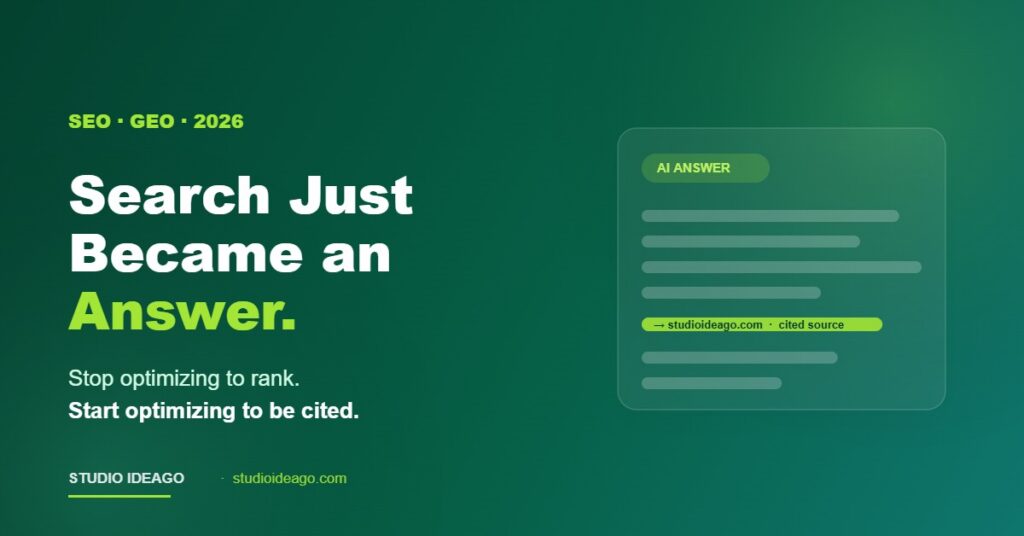
For twenty years, «ranking on Google» meant one thing: earning a blue link near the top of a page of blue links. In 2026 that page barely exists. AI Mode — Google’s Gemini-powered, ChatGPT-style answer experience — stopped being an opt-in tab and quietly became the default way a growing share of people search. At the same time, a UK regulator forced Google to hand publishers an opt-out switch, and a brutal core update reshuffled who gets cited. Three moves, one direction: the search result is turning into an answer, and your job is no longer to rank on the page — it’s to be the source the answer is built from.
SEO · GEO
What Actually Changed in Google Search in 2026?
Three things happened in quick succession, and together they matter far more than any single one. First, AI Mode became the default answer experience rather than a lab experiment you had to switch on. Instead of ten links, more searches now return a synthesised answer with a handful of cited sources underneath — and most people never scroll past it. The click you used to compete for often no longer gets made.
Second, the May 2026 core update finished rolling out on June 2 after twelve days — and it hit harder than March’s. The pattern was unambiguous: sites that compile, rephrase or lightly summarise what already exists lost ground, while brands, official sources and pages with genuine first-hand data and expertise gained. Google is increasingly rewarding the thing an AI can’t generate on its own — original, verifiable substance.
Third, and most overlooked, publishers got a switch. On June 3, 2026 the UK’s Competition and Markets Authority issued a legally binding order — the first of its kind — forcing Google to let sites opt out of AI features. The result is a toggle in Google Search Console, under Settings → Search generative AI, that took effect June 17. Each property can be set to Include, Exclude or Inherit, controlling whether your content can appear in AI Overviews, AI Mode and AI Overviews in Discover — while staying fully indexed in ordinary results. It’s UK-first for now, with a global rollout promised but undated.
Google Search Console also started reporting your impressions and clicks from AI surfaces. For the first time you can see how often you’re cited inside AI answers — which means AI visibility just became a metric you can manage, not a black box you guess at.
Should You Use the New Opt-Out Toggle?
For almost everyone, no — and it’s worth understanding why the switch is more trap than gift. On the surface it sounds empowering: pull your content out of Google’s AI answers so it can’t be «summarised for free.» The instinct is understandable. If AI Overviews answer the question without a click, why feed the machine that’s eating your traffic?
Because opting out doesn’t bring the old clicks back — it just makes you invisible in the surface that’s growing while you stay visible only in the surface that’s shrinking. AI Mode and AI Overviews are becoming where the search happens. Excluding yourself means the answer still gets written; it just gets written from your competitors’ content instead of yours. You don’t protect your authority by hiding from the place people now read — you hand it to whoever stayed.
There’s a narrow exception. If your business model is genuinely built on on-page monetisation — ad impressions, gated content, affiliate clicks that only pay when someone lands on your page — and you have data showing AI citations cannibalise rather than assist that model, the toggle is a legitimate lever to test. But for consultants, agencies, SaaS and B2B brands whose site is a credibility and lead-generation engine, being cited by name inside an AI answer is the modern equivalent of ranking first. That’s not a leak to plug. It’s the goal.
How Do You Actually Get Cited in AI Answers?
Here’s the reassuring part Google keeps repeating, and it’s true: «optimising for generative AI search is optimising for the search experience — it’s still SEO.» There is no separate GEO discipline with secret levers. What changed is the weighting. The signals that make you quotable to a language model are a sharpened version of the signals that already made you rank. Concretely:
1. Answer the question in the first two sentences. AI systems extract self-contained answers. Lead each section with a direct, standalone response to a real question, then expand. Buried conclusions don’t get quoted — front-loaded ones do. Structure pages around the questions your buyers actually type, with the answer sitting right under the heading.
2. Bring first-hand data and a point of view. The May core update was a referendum on originality. Proprietary numbers, tests you ran, a named expert with an opinion, a framework you built — these are the things a model can’t synthesise from thin air, so it cites the source. Aggregating what everyone else already said is now actively penalised, not just ignored.
3. Make the machine’s job easy. Clean structure, descriptive headings, FAQ and How-To schema, clear entity names, and factual consistency across your site all raise the odds of extraction. This isn’t about gaming anything — it’s about being unambiguous. And treat AI Mode and AI Overviews as two audiences, not one: analyses suggest only a small share of citations overlap between them, so breadth of well-structured, genuinely useful pages beats one hero article.
4. Watch the new report. Now that Search Console shows AI-surface impressions and clicks, treat it like any other channel: see which pages get pulled into answers, what they have in common, and make more of that. AI visibility stopped being unmeasurable the moment Google gave you the dashboard.
You’re no longer competing for a position on the page. You’re competing to be the source the answer is assembled from — and the entry fee is original substance a model can’t fake.
Rank-thinking optimises a page. Citation-thinking optimises to be quoted. In 2026, only the second one compounds.
Do you know whether AI is citing you or your competitor?
Most brands have no idea how often they show up inside Google’s AI answers — or which pages are doing the work. I help teams read the new Search Console AI reports and restructure their content so they get quoted, not skipped.
The Bottom Line: Optimise to Be Quoted, Not Just Ranked
AI Mode as default, a core update that rewards originality, and an opt-out toggle most people shouldn’t touch — read together, they describe a search engine that has stopped being a list of links and become an answer machine. The brands that win the next phase aren’t fighting that shift or hiding from it. They’re making themselves the most quotable source in their category: first-hand data, direct answers, clean structure, a real point of view.
This is the same discipline behind getting cited by answer engines generally — the argument I made about AEO and agentic AI — and it sits downstream of a bigger drift: the platforms keep making their data more ephemeral and their algorithms more opaque, the same pattern behind Google’s quiet data-retention cut. The page you used to rank on keeps losing importance. The source behind the answer keeps gaining it.
Don’t opt out of the future of search. Become the thing it’s built from.
Make your brand the source AI cites
I help consultants, agencies and B2B teams turn their content into something Google’s AI answers quote by name — auditing your AI-surface visibility, restructuring pages for extraction, and building the original, data-backed substance the 2026 core updates reward. Practical, measurable, no GEO snake oil.