Most marketing teams still argue about measurement as if they have to pick a winner: MMM or attribution or incrementality. That framing is exactly why so many of them are flying blind in 2026. Cookies are gone, multi-touch attribution quietly stopped working for paid social, and AI is now sitting inside the measurement workflow as a teammate rather than a report generator. The teams pulling ahead aren’t the ones who chose the «right» method — they’re the ones who learned when to use each, and wired the outputs straight into budget decisions. Here’s the decision framework.
Analytics & Measurement
Why Did Multi-Touch Attribution Stop Working?
For a decade, multi-touch attribution (MTA) was the default answer to «what’s driving revenue?». You stitched together every touchpoint, assigned fractional credit, and optimized. It depended on one thing: being able to follow a single user across channels and sessions. In 2026, that foundation is largely gone.
Third-party cookies are deprecated, Apple’s ATT cut off a huge slice of mobile signal years ago, and state-level privacy laws keep tightening what you can collect. The result is blunt: MTA stopped reporting reliably for paid social and large parts of display. Roughly 43% of teams that adopted marketing mix modeling cite signal loss as the primary trigger — they didn’t fall in love with MMM, their attribution stack simply broke.
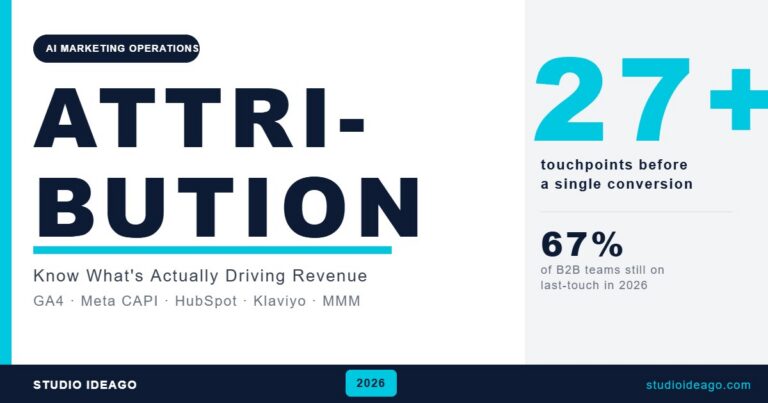
This is the same structural story we traced in Marketing Attribution in 2026: What’s Actually Driving Revenue. That piece asked which signals still tell the truth. This one answers the next question: given that no single method is trustworthy on its own, how do you actually decide what to measure with what?
Stop asking «which measurement tool is best?» Start asking «which question am I answering, and over what time horizon?» The method follows the question — not the other way around.
MMM vs MTA vs Incrementality: Which One, and When?
These three methods answer different questions on different clocks. Choosing between them is a category error. The skill is knowing which job each one does well — and where each one lies to you.
| Method | Best for | Time horizon | Watch out for |
|---|---|---|---|
| MMM | Quarterly & annual budget allocation across ALL channels, including offline | Slow (monthly/quarterly) | Coarse granularity; can’t optimize a single ad |
| Incrementality | Proving causal lift before you scale spend on a channel | Medium (test duration) | Needs design discipline; not always-on |
| MTA | Daily campaign-level optimization within already-validated digital channels | Fast (daily) | Unreliable where signal is lost (paid social, display) |
Read that table as a sequence, not a menu. MMM sets the strategic allocation: how much goes to paid search vs. social vs. brand vs. offline this quarter. Incrementality validates the causal claims MMM and your platforms make, before you pour budget into them. MTA then handles the day-to-day tuning inside the channels you’ve already proven work. Each hands off to the next.
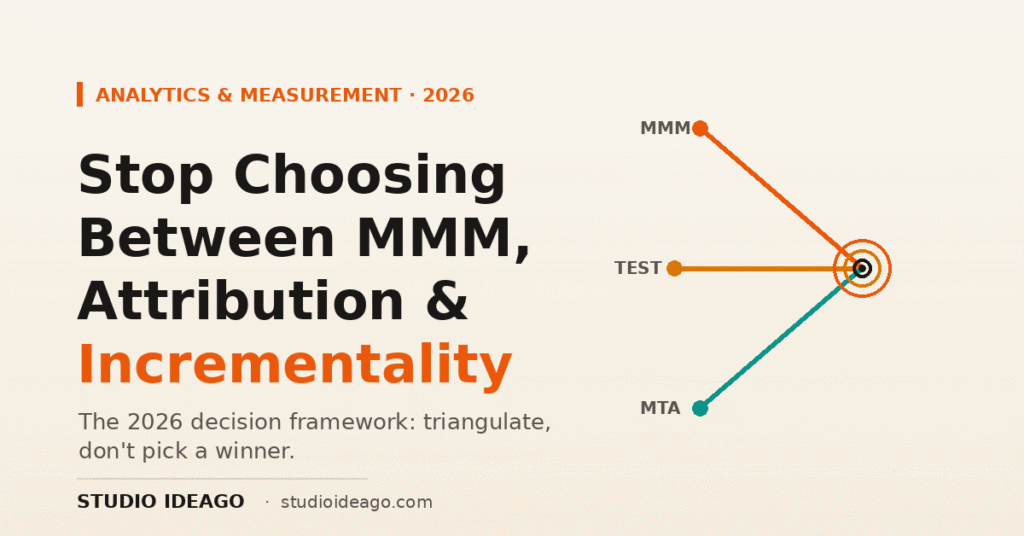
The winning move in 2026 isn’t picking a measurement method. It’s triangulation: MMM for the big allocation, incrementality to prove causality, attribution to optimize inside validated channels — with the outputs actually wired into budget decisions.
A measurement framework nobody acts on is just an expensive dashboard.
Why Is Marketing Mix Modeling Suddenly Affordable?
MMM used to be the preserve of brands with $200K–$500K to spend on a consulting engagement and a team of in-house data scientists to interpret it. That gate is gone. Google’s open-source Meridian model collapsed the cost of entry to a few weeks of in-house work, and 38% of new MMM adopters say it’s the reason they could afford to start at all.
The methodology itself also grew up. Modern MMM uses daily-grain data instead of weekly aggregates, integrates geo-experiments to calibrate causal lift, and uses AI-driven prior calibration in place of consultant intuition — rebuilt monthly rather than annually. That’s the difference between a model that tells you what happened last year and one that informs what you spend next month.
The adoption numbers reflect it. Mid-market and enterprise B2B teams sit at around 31% MMM adoption, five points above the cross-sample average. The sub-$10M cohort trails at 14%, mostly because in-house data capacity is still thin there — which is precisely where a consultant or a lean external team earns its keep.
Geo-experiments are the privacy-proof bridge
The most underrated technique in the 2026 stack is the geo-experiment: hold out a region, run the campaign everywhere else, and measure the difference. Because it works on aggregated location data rather than user-level identity, it sidesteps the privacy wall entirely. Across a dataset of 225 geo and holdout experiments, the median incremental ROAS landed at 2.31, with 88% of well-designed tests reaching statistical significance. That’s the causal proof MTA can no longer give you — and it’s how modern MMM calibrates itself.
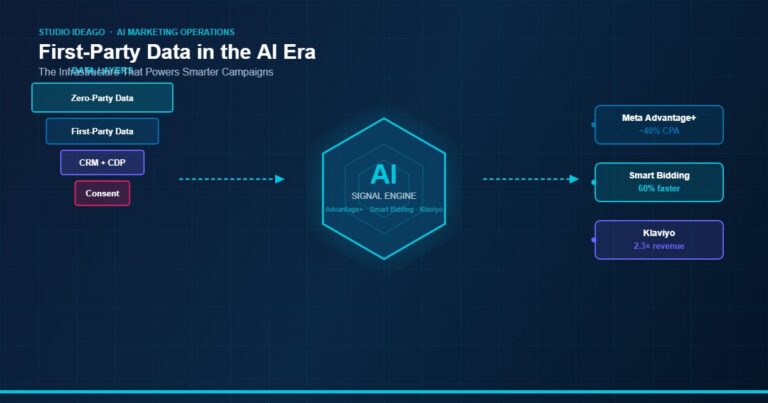
None of this works on fragmented data. MMM, geo-experiments, and incrementality all assume clean, unified inputs. If your CRM, ad platforms, and analytics don’t reconcile, you’re modelling noise. We went deep on that foundation in First-Party Data in the AI Era.
Not sure which method your spend actually needs?
Most teams over-invest in dashboards and under-invest in causal proof. I help B2B teams build a triangulated measurement stack — MMM for allocation, geo-tests for causality, attribution for tuning — sized to their budget and wired into real decisions.
What Does AI Actually Add to Measurement in 2026?
There’s a lot of noise about «AI-powered measurement.» Strip away the marketing and AI plays three concrete, additive roles — none of which replace the methods above, all of which make them faster and less dependent on a specialist.
It calibrates the models. AI-driven prior selection in modern MMM replaces the part that used to be consultant intuition — the educated guesses about how channels behave. That’s what lets a model rebuild monthly instead of annually.
It runs the analysis loop. Agentic AI is now deployed into the measurement workflow as a contributing teammate: pulling the data, flagging anomalies, drafting the read, and proposing the next test — so a lean team can operate a stack that used to need a dedicated analyst.
It shortens the feedback loop. The whole point of modern measurement is acting faster. AI compresses the time between «the test concluded» and «we’ve reallocated budget» from weeks to days. If you’re building that operating cadence, it’s the same logic we covered in Loop Marketing — measurement is the Evolve stage of the loop.
A Practical Stack You Can Actually Run
Forget the enterprise version with a measurement team of twelve. Here’s the lean, 2026-realistic version for a mid-market B2B team or the consultant running their stack:
1. Annual/quarterly: Run an MMM (Meridian or a vendor) to set top-line allocation across paid, owned, earned, and offline. This is your map of where money should go.
2. Before scaling any channel: Run a geo-experiment or holdout to prove the lift is real. Don’t scale on platform-reported ROAS alone — platforms grade their own homework.
3. Daily/weekly: Use attribution (GA4, platform data) only inside channels you’ve already validated, for tactical optimization — never as the source of truth for whether a channel works.
4. Always: Keep the data layer clean and let AI run the loop — pull, flag, read, propose. The measurement only creates value when the output changes a budget line within the same cycle.
The Bottom Line: Triangulate, Then Act
The measurement debate of the last decade — MMM versus attribution versus testing — was always a false choice. In a post-cookie, AI-assisted 2026, no single method is trustworthy alone, and that’s fine, because they were never meant to do the same job. MMM allocates, incrementality proves, attribution tunes. AI makes the whole loop fast enough to matter.
The teams that win aren’t the ones with the most sophisticated model. They’re the ones whose measurement actually moves money — where a concluded geo-test changes next month’s budget, not next year’s slide deck. Triangulate the methods, keep the data clean, let AI run the loop, and make sure every read ends in a decision.
Measurement isn’t a reporting function anymore. It’s the steering wheel. The only question is whether yours is connected to the wheels.
Build a measurement stack that moves budget, not just dashboards
I help B2B marketing teams design a triangulated, privacy-proof measurement stack — MMM for allocation, geo-experiments for causal proof, attribution for daily tuning — sized to your budget and wired into real decisions. No vanity reporting. A system that tells you where to spend next.