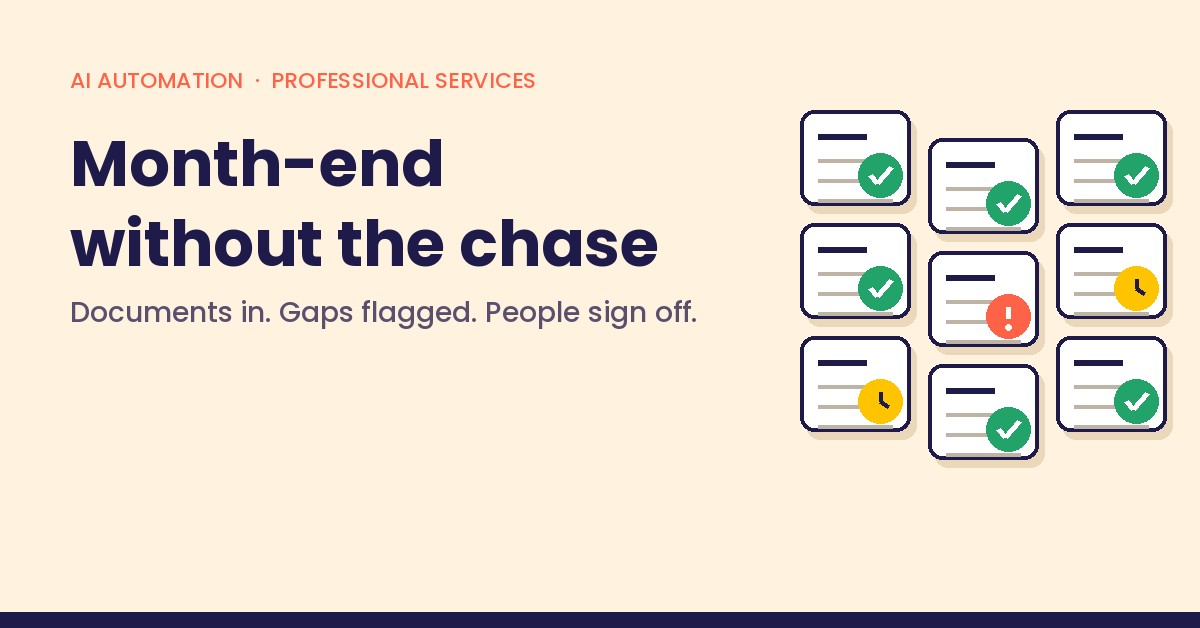
A mid-sized tax and advisory firm (name anonymised) spent the last week of every quarter chasing clients for invoices, bank statements and signatures. Qualified accountants were doing data entry and sending reminders by hand. We built an AI Crew that receives, classifies and checks every document, chases what is missing before the deadline, and hands the team a file that is ready to review — with a human signing off every filing. This is a composite case: client details are anonymised and illustrative, and no measured figures are implied.
accountants back on advisory work, partners with a live view of every client file
The firm looks after the bookkeeping, tax filings and payroll of several hundred small businesses and freelancers. Its accountants were good at the job — and spent most of their time on everything around it. Clients sent invoices through email, WhatsApp and photos of receipts, often a few days before a filing deadline. Someone had to open each one, work out what it was, key the data in, notice what was missing and write to the client to ask again.
Every quarter the same pattern repeated: a quiet first month, then a last week of overtime, late nights and avoidable mistakes. Partners could not see which client files were complete without asking around. Junior staff burned out on repetitive work, and senior staff had no time left for the advisory conversations that clients actually valued and would pay more for.
The firm had tried a generic document portal, but clients ignored it, because it asked them to change their habits. Whatever came next had to meet clients where they already were, and it had to respect the strict confidentiality that comes with handling other people’s financial records.
Invoices, receipts and statements arrive by email, WhatsApp or upload, in any format. The AI Crew identifies the client, classifies the document, extracts the key fields and files it in the right place. Anything it is unsure about goes to a person with the reason attached, rather than being guessed. Clients keep sending things the way they always did.
For each client and each deadline, the system holds a checklist of what a complete file contains. It compares what has arrived against what is expected and flags gaps in plain language: the March bank statement, a missing invoice number, a payroll change. The team opens a file and sees at once whether it is ready, nearly ready or blocked.
Instead of mass emails, clients receive short, specific nudges through their preferred channel, scheduled ahead of the deadline and escalating gently. Replies are read, matched to the right file and acknowledged. Common questions — “did you receive my invoice?” — are answered automatically, with a person stepping in whenever the question needs judgement.
Nothing is filed without an accountant’s review. Data stays inside the firm’s approved environment, access is role-based and every automated action is logged and explainable. A weekly digest tells partners which clients are complete, which are at risk and where the team’s hours actually went, using AI automation that supports the people rather than replacing their judgement.
We sat with the team through a real filing cycle, timed each task and listed every point where a document was opened, re-keyed or chased. That produced a ranked list of what to automate first, what to leave to people, and the privacy rules every step had to respect.
We built document reading, classification and the per-client checklists, and ran them in shadow mode alongside the manual process. Accountants compared the outputs with their own work and corrected the agent until they trusted it, one client segment at a time.
With the foundations stable we switched on scheduled client nudges, automatic acknowledgements and the weekly digest. We tuned the tone with the partners so that every message sounded like the firm, and set clear escalation rules for anything sensitive.
Once the quarterly cycle ran smoothly, the same building blocks were extended to payroll inputs and new-client onboarding. The team now spends its quarter-end reviewing and advising instead of chasing and typing.
Automation in a regulated, relationship-driven business works when it takes the repetitive work away and leaves the judgement, and the signature, with people.
We work with a limited number of clients to keep the quality high. If this case resonated, let's talk.
