How a 14-Clinic Healthcare Group Turned Missed Enquiries into €3.2M of Booked Treatments with an AI Crew
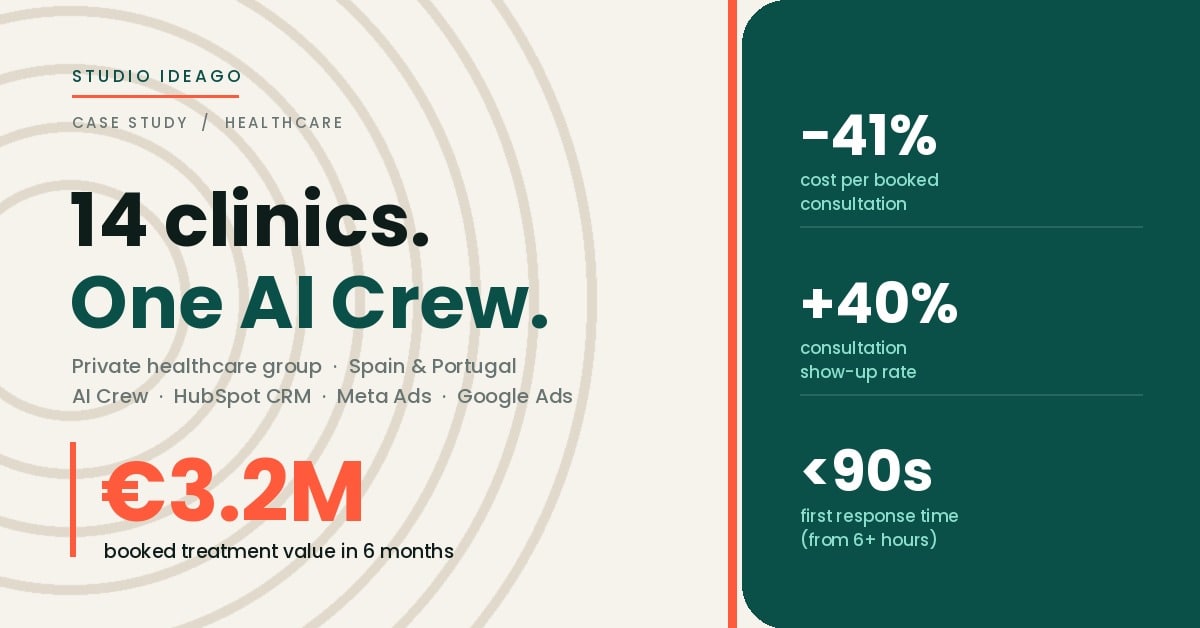
Vitania Clinics (name anonymised) was generating more enquiries than it could handle. Patients wrote on WhatsApp, filled in Meta lead forms and called reception — and then waited six hours or more for an answer while each of the 14 clinics worked from its own agenda, its own spreadsheet and its own idea of what a «lead» was. We built them an automated marketing department — an AI Crew answering in under 90 seconds, 24/7 — and rebuilt the CRM and the paid media engine around booked treatments instead of raw leads.
in six months, with cost per booked consultation down 41% and the show-up rate up from 58% to 81%
The situation
The challenge
Vitania Clinics (name anonymised) runs 14 private dental and aesthetic medicine clinics across Spain and Portugal, selling treatments with an average value between €1,800 and €6,500. Demand was never the problem. The problem was everything that happened after someone raised their hand. Enquiries arrived through four disconnected doors — Meta lead forms, Google local campaigns, WhatsApp and the reception phone — and each clinic handled them differently. Reception staff called back when the waiting room emptied, which in practice meant six hours later, or the next morning, or never on a Friday afternoon. Four out of ten booked consultations never showed up. Head office had no way of knowing which of the fourteen local ad budgets produced actual treatments rather than form fills, so spend was allocated by intuition and by whichever clinic manager complained loudest. And because this is healthcare, none of it could be fixed with a generic sales-automation template: consent, data minimisation and the strict separation between commercial and clinical data had to be designed in from the first day, not bolted on afterwards.
Our approach
What we built together
An AI Crew that answers every enquiry in under 90 seconds
We built an automated front desk that never closes. Every enquiry — WhatsApp, lead form, missed call, web chat — is picked up, identified by treatment interest and nearest clinic, and answered with a personalised message within 90 seconds, in Spanish or Portuguese. The AI Crew checks live availability, offers real slots, books the consultation into the right clinic’s agenda and hands the human team a patient who is already qualified and scheduled. Reception staff stopped chasing and started welcoming.
One HubSpot CRM for fourteen clinics
We replaced fourteen private spreadsheets with a single portal: one pipeline per treatment line, lifecycle stages that mirror the real patient journey (Enquiry → Consultation Booked → Attended → Treatment Accepted → Patient), ownership assigned by clinic, and dashboards each clinic manager can actually read. Consent capture, data minimisation and the hard separation between commercial and clinical records were designed into the property model from day one — no clinical data ever enters the CRM.
Meta and Google rebuilt around booked consultations
We stopped optimising towards leads. Offline conversions now flow back from HubSpot to both platforms, so Meta and Google learn from consultations that were actually attended, not from whoever filled in a form fastest. Campaigns were geo-fenced clinic by clinic to stop the fourteen locations bidding against each other, and creative was restructured by treatment line so each message reaches the patient it was written for.
A reminder programme that dismantled the no-show problem
A sequenced reminder flow — WhatsApp at 72 hours, a personalised confirmation at 24 hours, one-tap reschedule at any point — turned cancellations into moved appointments instead of lost patients. Every Monday the AI Crew delivers a per-clinic digest to head office: bookings, attendance, cost per booked consultation, treatment value, and the two actions that matter most this week.
Results
The numbers
How it happened
The process
Audit, patient journey and consent architecture
We shadowed the enquiry process in four clinics, timed every step, and mapped exactly where patients dropped out. In parallel we designed the data model: what the CRM is allowed to hold, how consent is captured and stored, and where the wall between commercial and clinical information sits. Nothing was automated before that architecture was signed off by the group’s data lead.
AI Crew build and HubSpot rollout
We built the AI Crew — intake, triage, availability check, booking and confirmation across WhatsApp, forms and web chat, bilingual from day one — and migrated fourteen clinics into a single HubSpot portal. Rollout ran clinic by clinic with two pilot locations first, so the reception teams shaped the flow before it reached everyone else. Adoption was near total by week six because the teams had helped design it.
Meta and Google restructure with offline conversions
We geo-fenced campaigns per clinic, rebuilt creative by treatment line, and wired offline conversion import from HubSpot into both platforms so bidding optimises towards attended consultations. Within six weeks budget had visibly reallocated itself away from the campaigns that produced cheap leads and towards the ones that produced patients. Cost per booked consultation began its fall.
No-show programme and Portuguese expansion
The reminder and reschedule flow lifted the show-up rate from 58% to 81%, which alone added more capacity than opening a fifteenth clinic would have. With attribution finally trustworthy, we scaled the same architecture into the Portuguese locations. By month six the group had booked €3.2M in treatment value and cost per booked consultation was 41% below baseline.
«We were never short of enquiries. We were short of fast answers. The AI Crew replies before the patient has closed Instagram — and for the first time I can tell you exactly which euro of ad spend became a treatment, in which clinic, in which country.»
— Marketing Director, Private Healthcare Group — Spain & Portugal