Independent HubSpot consulting across every hub: Marketing, Sales, Service, Content, Commerce, Data and Breeze AI. Implementation, migration, automation and CRM clean-up, run by one senior consultant with 12+ years in B2B, not by a rotating account team.
Studio Ideago is an independent HubSpot consultancy for B2B companies in the US and Europe. It implements new HubSpot portals, migrates CRMs from Salesforce, Pipedrive, Zoho or spreadsheets, rescues portals that were set up badly, and switches on Breeze AI only where the data supports it.
Typical timelines are 3 to 5 weeks for one hub and 6 to 12 weeks for a multi-hub rollout.
Lifecycle stages with real exit criteria, lead scoring, nurture workflows, forms and landing pages, and campaign attribution you can defend in a board meeting.
Pipelines that match how your team really sells: deal stages, required properties, quotes, sequences, meeting links and forecasting that stops being a spreadsheet.
Shared inbox, ticket pipelines, SLAs, knowledge base and surveys, so support history lives on the same record as the deal that created it.
Blog, pages and content remix inside HubSpot, structured so search engines and AI assistants can quote you, not just index you.
Quotes, payments, invoices and subscriptions connected to the deal record, plus revenue reporting that reconciles with what finance actually sees.
Deduplication, data quality rules, custom objects, and two-way syncs with your ERP, Shopify, Salesforce or product database via API.
HubSpot ships AI features faster than most teams can evaluate them. We test them on live portals and tell you which ones to switch on, which to ignore, and what has to be fixed in your data first.
Breeze only performs as well as the CRM underneath it. We clean properties and associations first, then turn on the agents that genuinely save your team hours.
HubSpot Breeze: what to activate and what to skip →Custom agents that work inside your CRM instead of another disconnected tool. We scope them around a task with a clear owner, a clear input and a measurable output.
HubSpot Agent Hub explained →HubSpot now reports on answer-engine visibility. We structure your content and schema so AI Overviews, ChatGPT and Perplexity quote your pages, and we measure whether it converts.
HubSpot AEO breakdown →Connecting assistants like Claude to HubSpot with write access is powerful and risky. We set the permissions, the guardrails and the audit trail before anything writes to a record.
AI write access to HubSpot: what to lock down →Properties, lifecycle stages, pipelines, duplicates, workflows that fire twice, integrations that quietly stopped syncing. You get a written findings list, whether or not we work together afterwards.
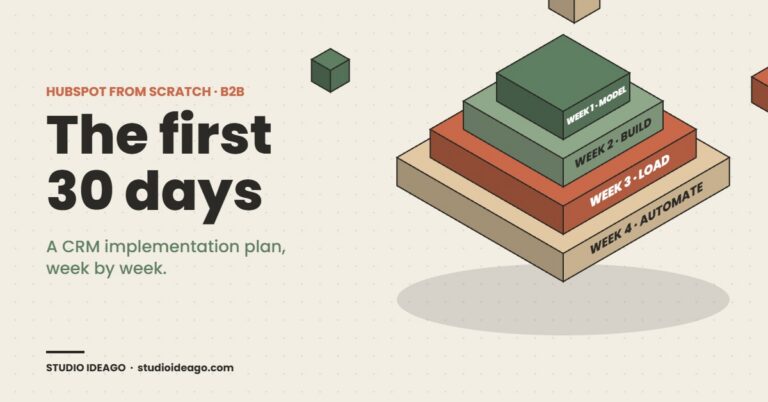
We agree the lifecycle definitions, deal stages and exit criteria with sales before touching the portal. Most failed implementations fail right here, not in the software.
Properties, automation, templates and reports built and tested in order. Migration from Salesforce, Pipedrive, Zoho or spreadsheets, with deduplication before import, not after.
Recorded training for each team, documentation in your portal, and three months of adjustments while real usage exposes what the design missed.
Implementation and onboarding for new portals, or a rescue of one that was set up in a hurry
CRM migration from Salesforce, Pipedrive, Zoho or spreadsheets, with the data cleaned on the way in
Ongoing HubSpot admin: automation, reporting, data hygiene and AI features, by the hour or by the month
Short answer: choose a HubSpot agency when you need a team producing content, design and ads around the CRM; choose an independent HubSpot consultant when the CRM itself is the project: implementation, migration, pipelines, automation and reporting for a B2B sales process. Many B2B companies start with the consultant and add an agency later for content.
Agency: account manager plus a rotating team. Consultant: the same senior person from audit to go-live.
Agency: ongoing content and campaigns at volume. Consultant: CRM design, migrations, sales pipelines and portal rescues.
Agency: monthly retainer. Consultant: fixed-scope project after the audit, then hourly or monthly admin if needed.
A HubSpot consultant designs, implements and fixes your HubSpot portal so it matches how your company actually sells and serves customers: lifecycle stages, pipelines, properties, automation, integrations, reporting and AI features. At Studio Ideago the same senior consultant audits, builds and trains, with no hand-offs to a junior team.
A single-hub setup for a small B2B team is usually live in 3 to 5 weeks. A multi-hub rollout with a migration and integrations runs 6 to 12 weeks. The variable is almost never HubSpot: it is how quickly your team agrees on definitions and hands over clean data.
A HubSpot agency makes sense when you need many hands at once: content, design, ads and CRM in one retainer. An independent HubSpot consultant makes sense when the CRM itself is the project and you want one senior person who owns the design end to end and works directly with your sales and marketing teams. Here the person who audits your portal is the person who builds it, with no hand-off to a junior team.
Yes, and it is a large part of the work. Typical findings: lifecycle stages with no exit criteria, duplicate contacts from an unmanaged import, workflows that contradict each other and reports nobody trusts. The audit tells you what to fix and in what order.
It depends on the state of your data. Breeze summaries and drafting help almost immediately. Agents and predictive scoring only work once properties and associations are consistent. Each feature is tested on your portal and you get a keep/skip list, not a blanket recommendation.
Projects are quoted as a fixed scope after the audit. Ongoing admin is billed hourly or as a monthly retainer. HubSpot licences are paid by you directly to HubSpot and are always quoted separately from consulting fees.

CRM Implementation · B2B Most HubSpot implementations for industrial and B2B companies fail in the same place, and it is not the…

CRM · RevOps Every stalled CRM implementation I have been called into had a lifecycle stage model. Usually a good one. Subscriber,…

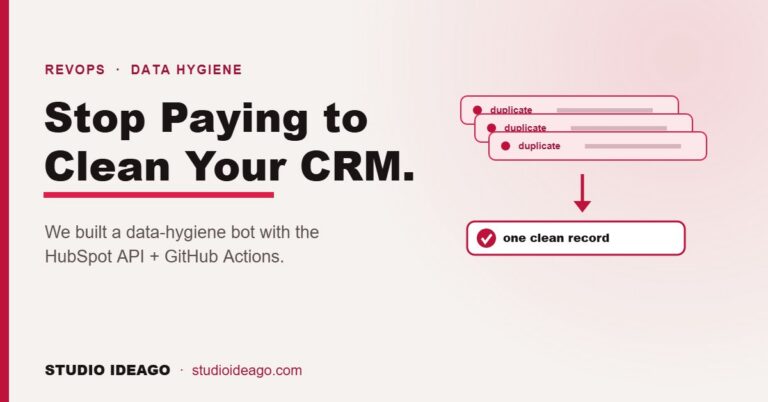
Every CRM rots. Contacts change jobs, forms get filled with junk, the same company lands in your database three times under three…
Thirty minutes, screen shared, looking at your actual portal. You leave with the three fixes that matter most, whether you hire me or not.