 Nacho Hernández
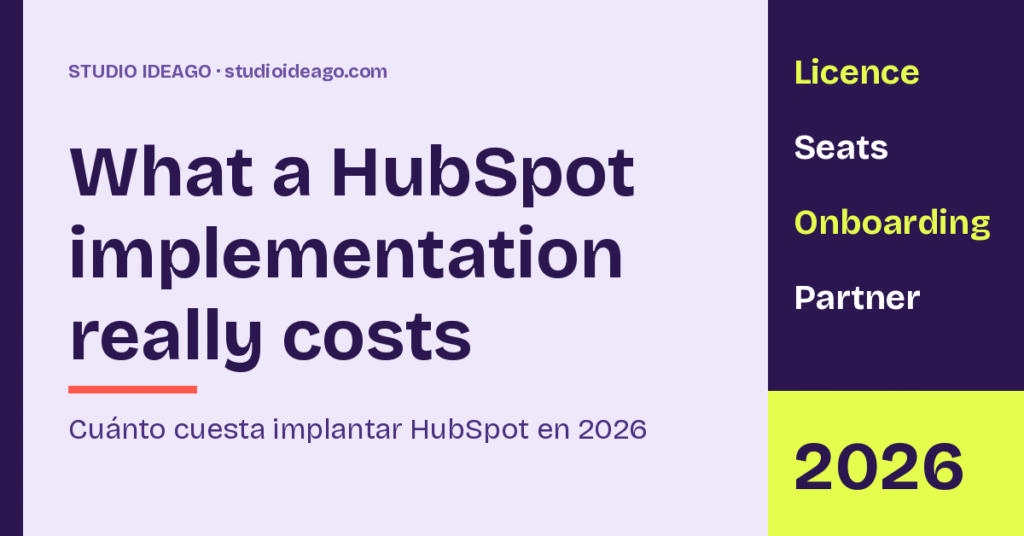
A small-business HubSpot implementation costs three things, not one: the licence (now priced by seats, and in some regions by credits), HubSpot’s own mandatory onboarding fee on Professional and Enterprise, and the work of configuring the portal, whether a partner, a freelancer or your own team does it. On HubSpot’s US Marketing Hub page the required onboarding fee is $3,000 for Professional and $7,000 for Enterprise (checked October 2026). Everything beyond that depends on scope, and scope is where budgets slip.
I run HubSpot implementations for B2B companies, so this is the breakdown I use when someone asks what a realistic budget looks like, including what the recent seat changes mean for it. HubSpot is changing pricing region by region, so treat every figure below as a checkpoint and confirm it on HubSpot’s pricing page before you sign.
What are you actually paying for in a HubSpot implementation?
Most quotes blur five different costs together. Separating them is the fastest way to compare offers and to see which line you can actually reduce.
| Layer | What it covers | How it is priced | What to check |
|---|---|---|---|
| Licence | Edition, Core Seats, usage credits | Per seat per month, by edition; credits sold in packs or pay-as-you-go | Which edition you really need and how many people edit records |
| HubSpot onboarding | Mandatory guided setup on Professional and Enterprise | One-time fee; $3,000 and $7,000 for Marketing Hub in the US | Whether a partner’s engagement replaces it |
| Implementation work | Pipelines, properties, lifecycle stages, workflows, reporting, integrations, data migration | Scoped fee from a partner or freelancer | Scope by object, number of pipelines, migration assumptions |
| Internal time | Approving definitions, cleaning data, testing, training | Your team’s hours | Who owns the project on your side |
| Ongoing admin | Fixes, new properties, reporting, user management | Retainer, fractional admin or in-house | Who owns the portal after launch |
The licence is the visible cost, but it is rarely the one that decides whether the project works. Internal time and ongoing ownership are the two lines that most small teams leave out, and they are the ones that cause a clean launch to turn into a cluttered portal six months later.
How did HubSpot’s seat pricing change, and what does it do to your budget?
HubSpot now sells access by seat type. A Core Seat lets a user edit the hubs you have purchased and use HubSpot’s AI features; a View-Only Seat is free for paid portals and is for people who only need to see data. That distinction is the first budget lever: count the people who genuinely create and edit records, and give everyone else view access.
Two details on the current US Marketing Hub page matter for planning. Professional includes three Core Seats and Enterprise includes five, with additional seats priced per month by edition. And all Core Seats are priced at the highest edition across your subscriptions, so adding one Enterprise product can raise the seat price for everyone. Credits power the AI agents and some automation features, cost about one cent each beyond the monthly allowance, reset every month and do not roll over. Pay-as-you-go is now the default for credit packs bought from September 16, 2026, and once you buy extra capacity the account spend limit defaults to 50% above your monthly allocation, with alerts as you approach it. Set those limits on purpose: credit-consuming features can pause when the cap is hit.
On top of that, HubSpot began selling a seats-and-credits model to new customers in EMEA on October 1, 2026, replacing the old hub-by-hub structure with one edition per account. Partner write-ups say existing customers keep their current pricing and that no US date has been announced. On October 15, 2026, HubSpot also announced that eligible customers can exchange unassigned seats for credits, or swap between seat types, in the middle of a contract, with credits not convertible back into seats. Seats are not going away; they now sit alongside credits. Their seat prices differ from one write-up to the next, so I would not build a budget from any blog post, including this one. Ask HubSpot sales for a written quote that lists seat types, included credits and the onboarding fee separately.
How much does a partner implementation cost for a small business?
There is no honest single number, and any partner who quotes one without looking at your data is guessing. What I can give you is what moves the price. Data migration, including deduplication, field mapping and validation, is usually the largest variable. Next come the number of pipelines and lifecycle stages, the workflows and reports you want live on day one, any integrations with billing, ERP or a product database, and how much training your team needs.
For orientation only: one European partner guide quotes roughly €6,000 to €25,000 for a mid-sized build with data migration, and wider ranges above that. Those are not US quotes and not a price list. A small team with one pipeline, reasonably clean data and no integrations should sit well below that mid-sized range; a company migrating from another CRM with several integrations will sit above it. If you are coming from Salesforce, my Salesforce to HubSpot migration checklist shows which decisions drive that scope.
Where does a HubSpot implementation budget leak?
The same five leaks show up repeatedly. Buying Professional or Enterprise for a feature you will not use in the first year. Giving every employee a Core Seat instead of a view seat. Migrating every record because it is easy to export. Building workflows before sales and marketing agree on definitions, which is why I push teams to settle lifecycle stages and exit criteria first. And launching without a named owner, which turns the portal into a maintenance bill; the options are laid out in my piece on fractional, agency or in-house HubSpot ownership.
If you want to see where the implementation hours go, the first-30-days plan walks through the order of work week by week.
How do you get a HubSpot implementation quote you can compare?
Ask each provider for the same things in writing, so the quotes line up:
- Scope by object. Contacts, companies, deals, tickets and any custom objects, with record counts.
- Onboarding treatment. Whether their fee replaces HubSpot’s onboarding fee, and how that is confirmed with HubSpot.
- Migration assumptions. What is cleaned, what is archived, and what happens if the data is worse than expected.
- Configuration limits. Number of pipelines, properties, workflows and dashboards included.
- Training and handover. Hours, format and documentation.
- Post-launch ownership. Who fixes things in month two, and at what rate, with coverage across US business hours if your reps are spread across time zones.
A quote that cannot answer these six points is a price for a conversation, not a price for a project.
Frequently asked questions
Is HubSpot onboarding mandatory?
On the US Marketing Hub page it is required for Professional ($3,000) and Enterprise ($7,000) and not required for Starter. Terms vary by hub and region, and some partners replace the fee with their own implementation fee, so confirm it in writing.
Can I implement HubSpot myself to save money?
Yes, on Starter or a simple Professional setup with clean data. The risk is not the software, it is the decisions around definitions, data and ownership. If you go solo, document your lifecycle stages and property naming before you build anything.
Do view-only seats cost anything?
HubSpot lists View-Only Seats as free for paid portals, though they cannot consume credits. Core Seats, which let users edit records, are what you pay for, so audit who needs edit access before you buy.
Will the new seats-and-credits pricing change my existing account?
Partner write-ups say existing customers keep their current pricing for now and that the model started with new EMEA customers on October 1, 2026. Since October 15 you can also swap unassigned seats for credits mid-contract, so check your renewal terms with HubSpot rather than assuming.
How long does a small-business implementation take?
It depends on data and integrations. A clean setup with one pipeline can be live in a few weeks; migrations from another CRM take longer. Be wary of fixed timelines offered before anyone has looked at your data.
Planning a HubSpot implementation and want the budget to hold?
I help B2B teams scope the project, pick the right edition and seat count, and launch a portal someone owns. Start with a short call and a realistic read on cost before you commit.