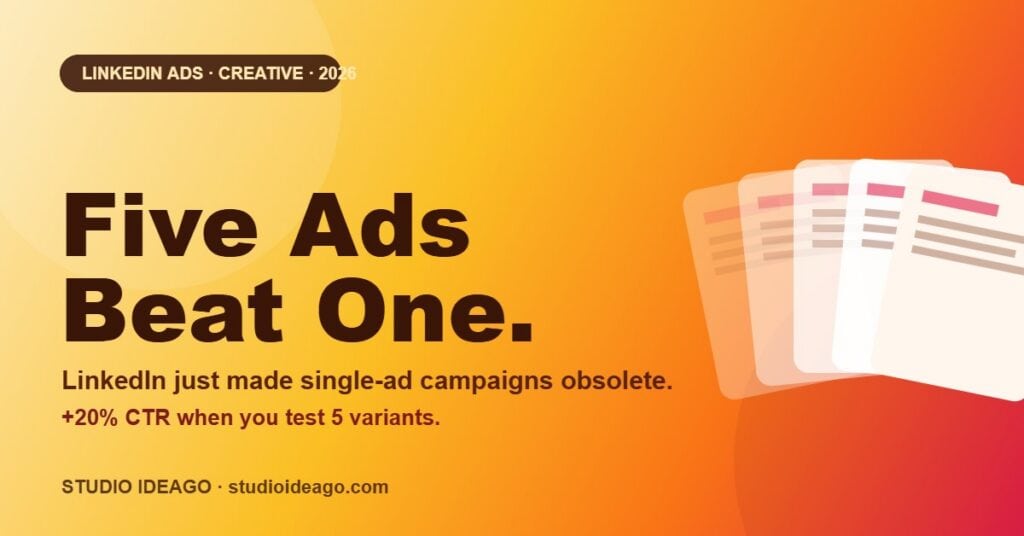
For years the standard LinkedIn Ads playbook was to write one tight ad, put real money behind it, and pray. On July 1, 2026 LinkedIn quietly made that playbook obsolete. It shipped a full creative suite inside Campaign Manager — Brand Kit, Draft with AI, Ads Personalization, AI ad variants and Flexible Ad Creation — and paired the launch with a number that should change how you budget: campaigns running five or more ad variants see more than 20% higher click-through rates than campaigns running a single ad. If you’re still shipping one creative per campaign, you’re now leaving measurable performance on the table. Here’s what changed and how to build a LinkedIn creative-testing system around it.
LinkedIn Ads · Creative
What Did LinkedIn Just Change in Campaign Manager?
On July 1, 2026 LinkedIn rolled out a connected set of creative tools that sit directly inside Campaign Manager, so you no longer bounce between a design file, a copy doc and the ad builder. Five pieces matter for advertisers.
Brand Kit lets you store your logos, fonts and colours once and apply them across every ad, so a rushed campaign still looks on-brand. Draft with AI generates ad copy from a short prompt or your landing page, giving you first drafts instead of a blank box. AI ad variants take one approved concept and spin out multiple versions — different headlines, angles, framings — in a few clicks. Ads Personalization tailors elements of the ad to the member seeing it. And Flexible Ad Creation lets you supply a pool of assets that LinkedIn assembles and tests per placement.
LinkedIn also added Auto-targeting and Draft with AI specifically for small and medium businesses, lowering the skill floor for teams without a dedicated media buyer. Read together, the release has one obvious intent: LinkedIn wants you producing and testing more creative, because its own data says volume-of-variants is now a performance lever, not a nice-to-have.
Why Do Five Ad Variants Beat One?
The 20% CTR gap isn’t magic — it’s a function of how LinkedIn’s delivery works. When you give the auction one ad, the system has nothing to optimise between; it shows that ad to everyone in your audience whether the angle lands or not. Give it five, and the algorithm can match the right message to the right member, shifting spend toward whichever variant each segment responds to. More variants means more surface area for the system to find fit.
There’s a second, slower effect: creative fatigue. On LinkedIn’s comparatively small, high-frequency B2B audiences, a single ad burns out fast — the same decision-makers see it repeatedly and stop noticing. A rotation of five keeps the impression fresh for longer, so your CTR degrades more gently over the campaign’s life instead of falling off a cliff in week two.
The catch is that «five variants» only works if they’re genuinely different. Five near-identical headlines don’t give the auction anything to choose between. The point of the new AI tools is to make real variation — distinct hooks, formats and value propositions — cheap enough that producing five is no longer a reason to skip the test.
Five variants beat one because they give the auction and the audience something to choose between. Five copies of the same idea are still, functionally, one ad.
How Do You Build a LinkedIn Creative-Testing System?
Treat the new tools as an assembly line, not a magic button. A repeatable system beats occasional bursts of inspiration.
1. Set the guardrails first. Load your Brand Kit before you touch Draft with AI. If the AI is generating copy and variants, you want brand colours, fonts and logo locked so every machine-made version still looks like you — not a generic template.
2. Test angles, not adjectives. Build your five around genuinely different ideas: one on the core outcome, one on a pain point, one on a proof point or stat, one on the objection your buyers actually raise, one on a contrarian take. That’s how you learn what your market responds to — not by A/B testing two versions of the same sentence.
3. Use AI for the first draft, a human for the final cut. Draft with AI and AI ad variants are excellent at producing volume and breaking blank-page paralysis. They’re mediocre at nuance, positioning and the specific language your niche uses. Generate ten, keep the five that a human would actually approve, and edit them so they don’t read like everyone else’s AI copy.
4. Give the test room to breathe, then read the right metric. Don’t kill a variant after a day. Let LinkedIn’s delivery distribute impressions, then judge on the metric that matches your objective — CTR for awareness and engagement, but cost-per-lead or pipeline for anything down-funnel. A high-CTR ad that produces junk leads isn’t a winner. Which is exactly why your measurement framework has to sit underneath the creative test, not beside it.
Ship five genuinely different angles per campaign, let AI draft them and a human approve them, and judge each on the metric that matches your goal — not on CTR alone.
The tools removed the excuse. Producing five strong variants is now cheap; running one is now a choice to underperform.
Running LinkedIn Ads with a single creative per campaign?
I help B2B teams build a LinkedIn creative-testing system — a Brand Kit that keeps AI output on-brand, a five-angle testing framework, and the measurement to tell a real winner from a vanity-metric one.
The Bottom Line: What Should You Do This Week?
Pick one active campaign and turn its single ad into five distinct angles using the new tools — Brand Kit locked, Draft with AI for the first pass, your own edit for the final cut. Give it two weeks, then compare CTR and cost-per-lead against the single-ad baseline you were running. LinkedIn’s own numbers say you should see the gap; your account will tell you whether it holds for your audience.
The wider pattern is the same one running through everything the platforms shipped this year: AI is making production cheap, which moves the advantage from who can make an ad to who tests and reads results well. The same shift is changing how B2B teams capture leads in the first place. The teams that win won’t be the ones generating the most creative — they’ll be the ones with a system for turning that volume into learning.
Volume is now free. Judgement is the scarce part. Build the system that supplies it.
Turn LinkedIn’s new creative tools into pipeline
I help consultants, agencies and B2B teams set up a LinkedIn Ads creative-testing system that actually moves cost-per-lead — brand guardrails, a five-angle framework, AI-assisted production with a human final cut, and measurement that separates real winners from vanity metrics.