
Categorías
Blog post

4 golden tips before you create your business

Welcome to Ideago Blog

4 golden tips before you start your own business

Are you planning to start your own business? Do you have an idea that you think could be profitable? Are you looking to become a freelancer and create your own brand?

Only In 2021, studio Ideago helped more than 20 new brands to go out into the market. This is why we thought it would be very useful to create these 4 simple golden tips to put into practice before investing time and money into a new business.

¡Attention!

These tips are for anyone to follow, you do not need any specific knowledge or previous technical skills.

share this on your social channels!

Share on facebook
Share on twitter
Share on linkedin

Let’s go for it!

Alright, now we are ready to start. We will assume that you already have a fairly clear idea of what you want to do (if not, the first thing then will be to define what you want). 

Before investing resources in your idea, we advise you to follow these 4 golden tips to analyze whether your business could work or not.

Tip 1 – Analyze the market

It may sound very complicated, but analyzing a market is something we do every day with our mobiles without realizing it.

Your business will surely be defined within an existing industry. Use search engines like Google to enter keywords related to the service or product you want to sell and analyze the results you get. For example, if you want to sell shoes in Spain, enter the keyword «sale of shoes in Spain» and check the results of at least the first two pages in Google.

Then perform the same type of search, that is, using keywords related to your business, but on your social networks (Youtube, Linkedin, Facebook, Instagram, TikTok, etc).

Very well! you have already started mapping the industry.

Now, when you carry out market analysis, one of the things you need to keep in mind is the number of results you get on Google, this will give you an idea of the dimensions of the market. If the results are very few, you know that the idea will be easy to communicate, since it does not have as much content competing for positions, but difficult to sell because there is no significant market, that is, a demand. On the contrary, if you get many results it means that there is a market for your idea, you just need to see how to differentiate yourself.

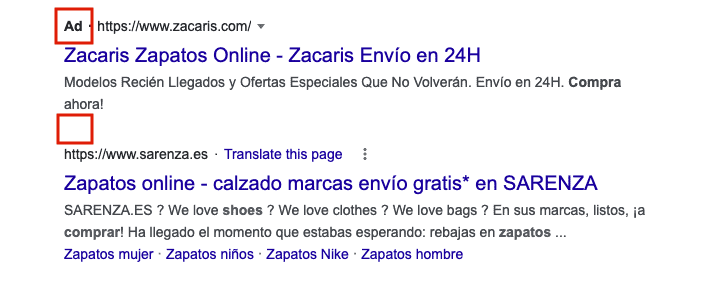
Within your analysis also check if there are any brands paying for ads in that category or industry. You can do this easily when you search on Google, the first results that have the word AD above is because they are brands that pay to be in that position. Below there is an example of how to differentiate a paid result like Google Ads, from an organic result.
Tip 2 – Analyze the competitors

When you are testing your keywords in Google you will learn about who your direct and indirect competitors will be and how many there are. Each brand that appears, each web page, will allow you to map the market in some way in your head, but t could also be very useful to write it down (Although you will do it in the next steps). You can also have an idea of which brand or competitor you want to resemble, which is a good exercise before starting a business to determine what your position will be in the market and what message will identify you.  In addition to your competitors’ websites, check their social networks, what channels they have, how they communicate, how often they publish and what type of interactions they receive from their community. Once these 2 points have been made, you will have a much solid and reasoned idea about whether you believe your business is going to work or not. Can you imagine your brand working after having made the previous points? Do you see your brand or idea competing in the market that you have been able to analyze? If you notice that your idea will not work, it is time to go back and rethink the strategy, the product and the service. If your business idea is still standing, you should continue with tip 3 and 4.

Tip 3 – Develop a business or marketing plan

Here we get into a bit of a mess, but a necessary mess. It is time to make a document that guides all our investment and our idea, this is called a business or marketing plan. Do not worry, it sounds difficult but you will see that it is something you can do without any problem.

Now that you’ve done some research on the industry, market, and competitors, and reasoned that your idea is still viable, it’s time to write your plan and strategy. We do this to create a document that can be shared and allow a group of people to align on the needs and goals of your brand.

Basically this document will be what guides the entire team on the direction of the company or brand. Make sure your plan covers at least the following points:

  • Market Analysis
  • Competitor Analysis
  • Definition of objectives
  • What position do I want in the market
  • Description of my idea or product/service.
  • What kind of communication will we do
  • What kind of channels will we embrace and with what creatives
  • We will define the budget
  • Planning in a calendar of the actions to be carried out.

But don’t worry if this is something you don’t want to do yourself. Many people hire agencies or professionals like Studio Ideago to help them with these types of documents. Hence the last tip for the well-being of your business.

Tip 4 – Look for professional advice

This is the last tip but not the least important. Whenever you have a business idea, it is highly recommended to seek advice from a marketing and business professional so they can give you their expert and external point of view, on the budget you plan to invest and on the goals you want to achieve, for example. This type of advice can give you ideas that you did not foresee, or light you up on a winding path such as creating your own business.

We hope that these simple steps will help you have a clearer vision about your idea or business and  the goals you want to achieve. Do not be discouraged, creating your own business is a difficult path with ups and downs, but if you like what you do, and surround yourself with the right people, in the end you will always succeed.

If you would like to discuss your idea with us, you can contact us here, or leave us your comment in the forms below. We’re happy to hear about your business and help you make it a profitable brand. 

About the Autor


Linkedin

Do you have any question for us?

We love hearing new challenges, complete the following form and we will answer you in less than 24 hours!

You might also be interested in the following related content

Categorías
Entrada de Blog

4 consejos dorados para crear tu negocio o marca

el blog de ideago

4 consejos dorados antes de comenzar tu negocio

¿Tienes pensado montar tu propio negocio? ¿Se te ha ocurrido una idea que crees que puede ser rentable? ¿Quieres lanzarte como autónomo y crear tu propia marca?

Sólo en 2021, en estudio Ideago hemos asesorado a más de 20 marcas nuevas para salir al mercado. Por eso creemos que sería de gran utilidad crear estos 4 simples consejos dorados para poner en práctica antes de invertir tiempo y dinero en un negocio nuevo.

¡Atención!

Estos consejos son para que cualquier persona pueda seguirlos, no necesitas ningún conocimiento específico ni tener capacidades técnicas profesionales previas.

Comparte en tus redes sociales!

Share on facebook
Share on twitter
Share on linkedin

¡Manos a la obra!

Muy bien, ahora sí, podemos comenzar. Daremos por sentado que ya tienes tu idea bastante clara sobre qué quieres hacer (si no es así, lo primero entonces será definir bien qué quieres). Ahora bien, antes de comenzar a invertir recursos en tu idea te aconsejamos seguir estos 4 consejos dorados para analizar si tu negocio será viable o no.

Consejo 1 – Analiza el mercado

Puede sonar muy complicado, pero analizar un mercado es algo que hacemos a diario con nuestros móviles sin darnos cuenta.

Tu negocio estará definido seguramente dentro de una industria ya existente. Utiliza los motores de búsqueda como Google para introducir palabras claves relacionadas con el servicio o producto que deseas vender y analiza los resultados que obtienes. Por ejemplo, si deseas vender zapatos en España, introduce la palabra clave “venta de zapatos en España” y comprueba los resultados de al menos las primeras dos páginas en Google.

Luego realiza el mismo tipo de búsqueda, es decir utilizando palabras claves relacionadas a tu negocio, pero en tus redes sociales (Youtube, Linkedin, Facebook, Instagram, TikTok, etc).

¡Muy bien! ya has comenzado a mapear la industria.

Ahora bien, cuando realizas análisis de mercados ten en cuenta la cantidad de resultados que obtienes en Google por ejemplo, esto te dará una idea de las dimensiones del mercado. Si los resultados son muy pocos sabes que será un producto/servicio fácil de comunicar, ya que no tiene tanto contenido compitiendo por las posiciones, pero difícil de vender porque no existe un mercado significativo es decir una demanda. Por el contrario, si obtienes muchos resultados significa que existe un mercado para tu idea, solo necesitas ver de qué forma entrar para diferenciarte. 

Dentro de tu análisis también comprueba si hay marcas pagando por anuncios en esa categoría o industria. Esto lo haces fácilmente cuando buscas en Google, los primeros resultados que tiene la palabra AD arriba es porque son marcas que pagan por estar ahi. A continuación un ejemplo de un anuncio en Google Ads, pago y otro orgánico.

Consejo 2 – Analiza la competencia

Cuando estés probando tus palabras claves en Google irás aprendiendo sobre quienes serán tus competidores directos e indirectos y cuántos hay. Cada marca que aparezca, cada página web, te permitirá ir mapeando el mercado de alguna forma en tu cabeza, o si quieres también puede ser muy útil escribirlo (Aunque ya lo harás en el siguiente paso). También podrás tener una idea de a cual marca o competidor te quieres asemejar, lo cual es un buen ejercicio antes de comenzar un negocio para determinar cuál será tu posición en el mercado y con qué mensaje te identificarán. 

Chequea además de los sitios web de tus competidores, sus redes sociales, qué canales tienen, de qué forma se comunican, cada cuanto publican y qué tipo de interacciones reciben de su comunidad. 

Una vez realizado estos 2 puntos, tendrás una idea mucho más firme y argumentada sobre si crees tu negocio es viable o no. 

¿Puedes imaginar a tu marca funcionando luego de haber realizado los puntos anteriores? ¿Ves a tu marca o idea compitiendo en el mercado que has podido analizar? Si notas que tu idea no funcionará es hora de volver para atrás y replantearse la estrategia, el producto y el servicio. Si tu idea de negocio aún sigue en pie, deberás continuar con los siguientes 2 consejos.

Consejo 3 – Desarrolla un plan de negocio o marketing

Aquí ya nos metemos un poco de lío, pero lío del necesario. Es hora de realizar un documento que guíe toda nuestra inversión y nuestra idea, esto se llama plan de negocio o  marketing. No te preocupes, suena difícil pero ya verás que es algo que puedes hacer sin problema. 

Ahora que ya has investigado un poco la industria, el mercado y los competidores y has razonado que tu idea aún es viable, llega la hora de escribir nuestro plan y estrategia. Lo escribimos para crear un documento que pueda compartirse y permitir a un grupo de personas alinearse sobre las necesidades y objetivos a trabajar. 

Básicamente este documento será lo que guíe a todo el equipo sobre la dirección de la empresa o marca. Asegúrate que tu plan cubra al menos los siguiente puntos:

  • Análisis de mercado
  • Análisis de la competencia
  • Definición de objetivos
  • Que posición quiero en el mercado
  • Descripción de mi idea o producto/servicio. 
  • Qué tipo de comunicación haremos
  • Que tipo de canales abrazaremos y con qué creatividades
  • Definiremos el presupuesto
  • Planificación en un calendario de las acciones a llevar a cabo.

Pero no te preocupes si esto es algo que no deseas hacer tu mismo. Muchas personas contratan agencias o profesionales como Ideago para que los ayude con este tipo de documentos. De aquí el último consejo para el bienestar de tu negocio.

Consejo 4 – Busca asesoramiento profesional

Este es el último consejo pero no el menos importante. Siempre que tengas una idea de negocio es muy recomendable asesorarte con algún profesional de marketing y negocios para que pueda darte su punto de vista experto y externo, sobre el presupuesto que piensas invertir y sobre los objetivos que quieres alcanzar por ejemplo. Este tipo de asesoramiento puede darte ideas que no tenías previstas, o alumbrarte en un camino sinuoso como el de crear tu propio negocio. 

Esperamos que estos simples pasos te ayuden a tener una visión más clara sobre tu idea o negocio y si será posible alcanzar los objetivos que deseas. No te desanimes emprender es un camino difícil con subidas y bajadas pero si te gusta lo que haces, y te rodeas de las personas adecuadas, al final siempre triunfarás.

Si te gustaría conversar sobre tu idea con nosotros, puedes contactarnos aquí, o dejarnos tu comentario en los formularios debajo. Estamos encantados de escuchar sobre tu negocio y ayudarte a llevarlo a cabo. 

Sobre el Autor


Linkedin

¿Tienes alguna consulta?

Nos encanta escuchar nuevos desafíos, completa el siguiente formulario y te responderemos en menos de 24 hs!

Tal vez te interese leer también sobre…